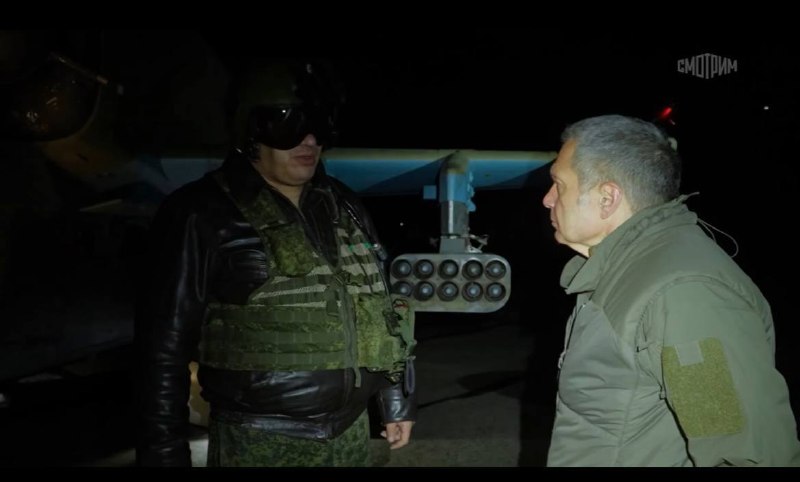
Russian Ka-52 helicopters received a new S-8VTs anti-UAV missile. S-8VTs is a special modification of the 80 mm aircraft missile from the S-8 family, adapted for hitting air targets, mainly as small aircraft type UAVs. The main feature of the ammunition is a proximity fuse and a fragmentation warhead. The missile does not have to hit the UAV directly: when approaching the target, the fuse is activated, and the harmful elements create a cloud of fragments. Main features: Caliber - 80 mm. Length - about 1.7 m. Weight - up to 17.5 kg. The warhead is a high explosive fragmentation. The declared destruction range is up to 4 km. The fuse is non-contact, programmable. In the basic configuration, the firing parameters of the missile are calculated by the helicopter's built-in system. In the photos shown, the Ka-52 is equipped with a unit of S-8VTs. According to the pilot, the helicopter can carry two blocks of ten missiles. In terms of functionality, the S-8VTs can be compared to the American APKWS, but their operating principles are different. The American system uses laser guidance, while the Russian S-8VT aircraft in a known configuration are designed to hit the target by calculating the point of encounter and detonate without contact. Russia also has the S-8L, a semi-laser-guided missile whose control principle is closer to APKWS. The appearance of the S-8VTs reflects the suitability of the helicopters' weapons for mass use in UAVs. The use of existing aircraft missiles with a different warhead makes it possible to expand the capabilities of military aviation in combating air targets without switching exclusively to special anti-aircraft missiles. VK Max Zen.
Russian Ka-52 helicopters received a new S-8VTs anti-UAV missile. S-8VTs is a special modification of the 80 mm aircraft missile from the S-8 family, adapted for hitting air targets, mainly as small aircraft type UAVs. The main feature of the ammunition is a proximity fuse and a fragmentation warhead. The missile does not have to hit the UAV directly: when approaching the target, the fuse is activated, and the harmful elements create a cloud of fragments. Main features: Caliber - 80 mm. Length - about 1.7 m. Weight - up to 17.5 kg. The warhead is a high explosive fragmentation. The declared destruction range is up to 4 km. The fuse is non-contact, programmable. In the basic configuration, the firing parameters of the missile are calculated by the helicopter's built-in system. In the photos shown, the Ka-52 is equipped with a unit of S-8VTs. According to the pilot, the helicopter can carry two blocks of ten missiles. In terms of functionality, the S-8VTs can be compared to the American APKWS, but their operating principles are different. The American system uses laser guidance, while the Russian S-8VT aircraft in a known configuration are designed to hit the target by calculating the point of encounter and detonate without contact. Russia also has the S-8L, a semi-laser-guided missile whose control principle is closer to APKWS. The appearance of the S-8VTs reflects the suitability of the helicopters' weapons for mass use in UAVs. The use of existing aircraft missiles with a different warhead makes it possible to expand the capabilities of military aviation in combating air targets without switching exclusively to special anti-aircraft missiles. VK Max Zen.
🇷🇺 Russia · Map
More on Radar
Want to see every report in real time?
Hundreds of sources worldwide, translated into your language, with alerts for what matters to you.
Sign up free Already have an account? Log in