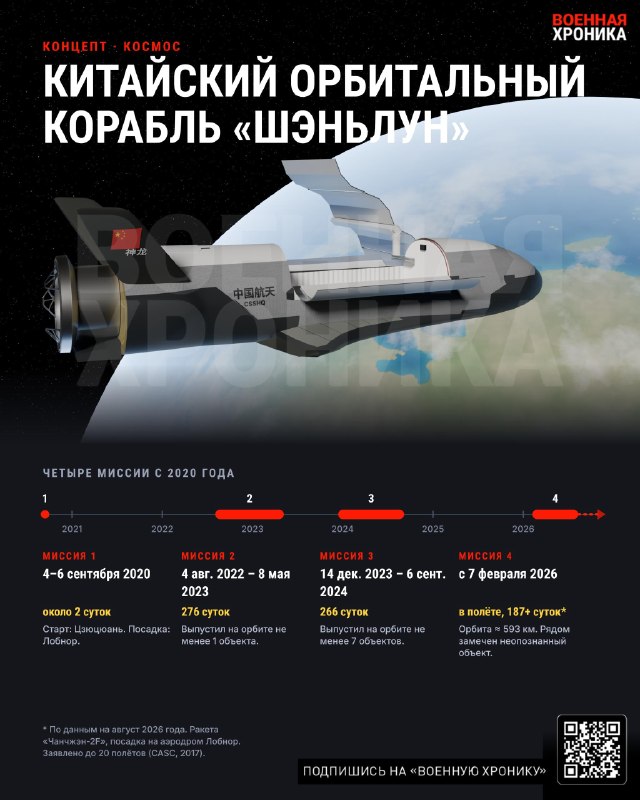
Regarding the Chinese spacecraft in orbit. It is clear that the PRC continues to test the Shenlong reusable space shuttle, which is able to maneuver in orbit and interact with other spacecraft. On February 7, 2026, the fourth launch of an experimental unmanned vehicle, known by the unofficial name "Shenlong" ("Divine Dragon") from the Jiuquan Cosmodrome took place. The Mertz Long-2F launch vehicle was used for the launch. In terms of design and intended purpose, the Chinese device is compared to the American X-37B orbital plane. Both are designed for long autonomous flights, conducting experiments in orbit and returning to Earth with the possibility of reuse. China rarely discloses the technical characteristics and missions of the Shenlong. Officially, Beijing only reports technology tests for reusable spacecraft. Previous assignments: - September 2020 - 2 days. - August 2022 - May 2023 - 276 days. - December 2023 - September 2024 - 266 days. During the second and third flights, space monitoring experts recorded the separation of small objects from the shuttle and subsequent rendezvous maneuvers. In some cases, there were signs of recapture of previously published devices. Such operations make it possible to test technologies for orbital rendezvous, testing satellites and interacting with other objects in space. Theoretically, they are applicable both for own satellite constellation service and for anti-satellite operations. In June 2026, LeoLabs discovered another unknown object near Shenlong. Apparently it was released by the shuttle itself. Its purpose has not been determined. The military significance of the program derives mainly from the ability to autonomously change course, approach other satellites and carry out payload operations without direct human intervention. VK Max Zen.
Regarding the Chinese spacecraft in orbit. It is clear that the PRC continues to test the Shenlong reusable space shuttle, which is able to maneuver in orbit and interact with other spacecraft. On February 7, 2026, the fourth launch of an experimental unmanned vehicle, known by the unofficial name "Shenlong" ("Divine Dragon") from the Jiuquan Cosmodrome took place. The Mertz Long-2F launch vehicle was used for the launch. In terms of design and intended purpose, the Chinese device is compared to the American X-37B orbital plane. Both are designed for long autonomous flights, conducting experiments in orbit and returning to Earth with the possibility of reuse. China rarely discloses the technical characteristics and missions of the Shenlong. Officially, Beijing only reports technology tests for reusable spacecraft. Previous assignments: - September 2020 - 2 days. - August 2022 - May 2023 - 276 days. - December 2023 - September 2024 - 266 days. During the second and third flights, space monitoring experts recorded the separation of small objects from the shuttle and subsequent rendezvous maneuvers. In some cases, there were signs of recapture of previously published devices. Such operations make it possible to test technologies for orbital rendezvous, testing satellites and interacting with other objects in space. Theoretically, they are applicable both for own satellite constellation service and for anti-satellite operations. In June 2026, LeoLabs discovered another unknown object near Shenlong. Apparently it was released by the shuttle itself. Its purpose has not been determined. The military significance of the program derives mainly from the ability to autonomously change course, approach other satellites and carry out payload operations without direct human intervention. VK Max Zen.
🇪🇬 Egypt · סיני · Map
More on Radar
Want to see every report in real time?
Hundreds of sources worldwide, translated into your language, with alerts for what matters to you.
Sign up free Already have an account? Log in