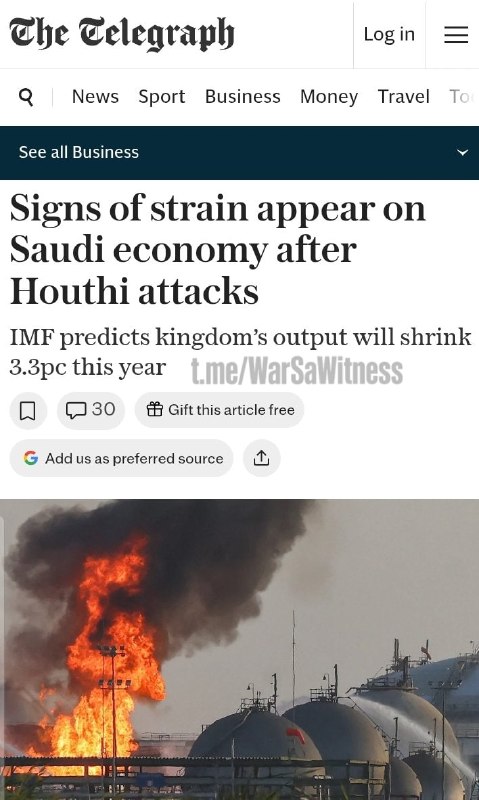
🇾🇪🇸🇦. Signs of tension in the Saudi economy are appearing following the Houthi attacks, with the IMF predicting that the kingdom's output will decrease by 3.3% this year.
📰️. The Telegraph:
A renewed barrage of Houthi drone and missile attacks on Saudi Arabia is once again casting a dark shadow over the oil-producing Gulf state's war-torn economy.
Offices in Riyadh's business district have been closed, and reports suggest many of the foreigners are leaving the country after being ordered to work from home.
The International Monetary Fund says the Saudi economy will contract by 3.3 percent this year, although the neighboring United Arab Emirates is completely avoiding any Iran-related contraction.
Reports indicate that the Saudi government this week was preparing to postpone its flagship global mining and minerals conference, scheduled for January, after already postponing the "Davos in the Desert" forum in October for a full year.
the rest of the gulf countries. Except for Iran. are slowly getting back to the pre-conflict status quo; For the Saudis, the situation seems to be getting worse.
Jason Tobey of Capital Economics said in a study: "Even if a renewed escalation in the war with Iran is avoided, the kingdom faces continuous Houthi attacks on its territory. ".
After a series of attacks on King Khalid International Airport in October, Iran-backed Yemeni rebels began targeting Riyadh's King Abdullah Financial District.
Vulnerabilities hit the office tower housing the country's $900bn (£680bn) sovereign wealth fund. The Public Investment Fund (PIF). on Tuesday, and injured 11 people.
This came after a pre-emptive strike a few days earlier and several attacks foiled by Saudi air defenses.
In recent days, the Houthis have moved to attack ports and oil installations in Saudi Arabia; An attack on a refinery in the Jazan region on Thursday killed one worker and injured several others.
A day earlier, the Houthis announced that they had attacked the refinery in Ras Tanura, the largest refinery in the country, located on the Gulf but connected by a pipeline to the Red Sea.
These attacks on the world's second-largest crude oil producer were enough to raise the price of Brent oil from about $90 a barrel three days ago to a record high of nearly $98 on Friday.
The high oil prices may help Saudi Arabia deal with the economic shock caused by its war with the Houthis; But in the budget published this week, the government acknowledged that it would have to cut spending to prevent the deficit from expanding.
Mr Tobi said: "If the Houthi attacks continue to affect activity in the non-petroleum economy, the government may find it difficult to withdraw the financial support provided this year. ".
He added: "The government may also be forced to increase military spending if it decides to increase response efforts against the Houthis. ".
The conflict with the Houthi rebels began in 2015, when the Saudis intervened in Yemen on the side of the government.
The fighting between the two sides stopped in 2022, and the Houthis turned the blame towards Israel; But the American-Israeli attack on Iran, the patron of the Houthis, reignited the Saudi conflict.
This two-front conflict has already forced the heir to the throne to greatly curtail his grand ambitions; He abandoned or postponed indefinitely many aspects of his major development project, Neom, including the planned 105-mile linear city, sports stadium and ski resort.
Meanwhile, the public investment fund has canceled the LIV golf tournament, which is costing more than $5 billion, and reports suggest it is now considering selling a 25 percent stake in Premier League soccer club Newcastle United.
It marks a retreat from the kingdom's generous spending on sports in recent years, with questions also growing about whether the country will be able to host ambitious sporting events amid the conflict.