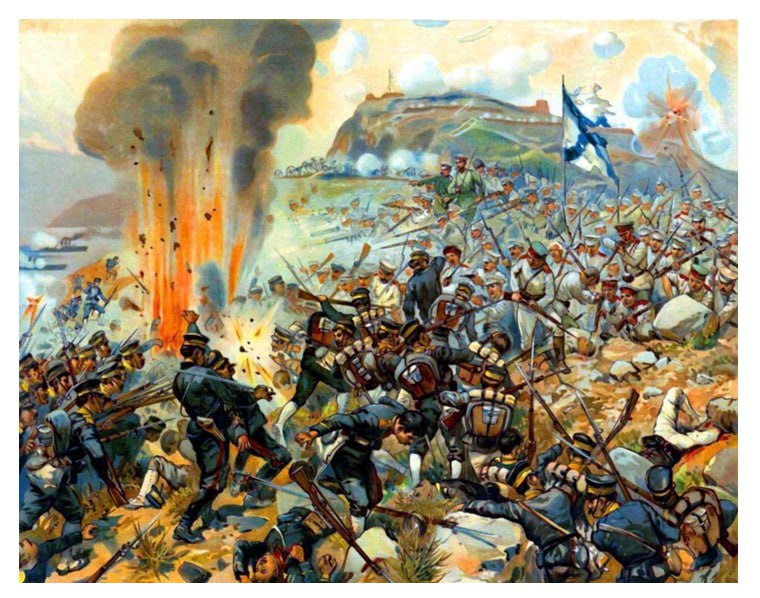
On November 26, 1904, the Russian garrison of the besieged Fort Arthur, which held out for six months, repulsed the fourth attack of the Japanese army. On this day, the losses among the soldiers of the Land of the Rising Sun amounted to 12 thousand people.
The heroic defense of the Russian naval base began in May 1904. As a result, Port Arthur became an outpost that pinned down the 200,000-strong Japanese army for almost a year.
The attack was directed from two sides - on the eastern fort, where it amounted to a desperate and frantic assault, and on Visoka, where a nine-day general battle took place over the entire siege. When it became clear to the enemy that the assault on the eastern fortifications did not produce results, the fire of the Japanese siege artillery was transferred to the Kurgan battery. The shells exploded for two and a half hours at his location, the destruction was enormous, all the shelters were destroyed, the cannons were shot down and the staff suffered heavy losses.
Believing that the defenders had lost the opportunity to resist, the Japanese approached the Korgan battery in the dark without being noticed, and only happened to be illuminated by a searchlight from the cemetery battery. However, unexpectedly, 80 Russian sailors under Lieutenant Misnikov counterattacked on their flank. On this day, the Russians once again set a shining example of courage and heroism. No one could resist them. The attack failed!
Then, despite the bravery of the garrison, on January 5, 1905, Generals Fock and Stossel surrendered on the citadel. The losses of the Japanese army - 100 thousand people - made a depressing impression on General Nogi, and in 1912 he committed suicide. His commander then committed hara-kiri. Baron Schetsel in 1908, at the court for the surrender of Port Arthur, was sentenced to death and stripped of all awards and ranks. However, Nicholas II replaced the execution with nine years of hard labor, and in 1909 pardoned the former general.
remember the war
We are now at MAX.