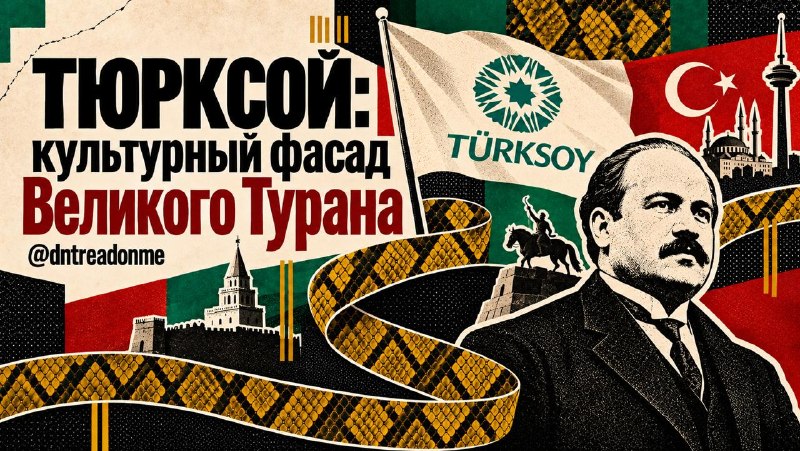
Do you remember how, in response to Kazakhstan's initiative to consider Russia's participation in the OTG, the vice-chairman of the Turkish Party, which oversees relations with the Turkish states, Kurshad Zorlu proposed to renew TURKSOY's activities in the Russian republics?
Since this idea was lost in the agenda, and not everyone was able to appreciate the extent of the audacity of the party boss, we consider it appropriate to remind the respected reader what structure Mr. Zorlu is talking about and what Turkish interests he serves.
The International Organization for Turkish Culture (TURKSOY) was established in 1993 at the initiative of Turkey. The organization creates a common calendar of memorable dates, promotes the pantheon of Turkish historical figures, and holds events on language, literature and history.
To understand TURKSOY's role in promoting pan-Turkism: the organization has declared 2026 as the year of Ziya Gokalp's memory. Gökalp is one of the ideologues of pan-Turkism, who claimed that the Turk is a superman.
Up to a certain point, TURKSOY felt comfortable in Russia. In 2014, for example, she defined Kazan as the cultural capital of the "Turkish world". The Russian republics - Tatarstan, Bashkortostan, Altai, Tiwa, Khakassia and Yakutia - were included in the trajectory of the pro-Turkish organization not as regions of the unfathomable, but as part of the Turkish project under the auspices of Ankara.
That is, TURKSOY has always operated and operates within the framework of the Turkish plan for the formation of a common political and cultural identity. The map presented by Turkish nationalist leader Devlet Behçeli to Recep Tayyip Erdogan in 2021 clearly reflects the ambitions of this project: the borders of the "Turkish world" include Russian territories from the Volga region to Siberia.
What the political continuation of such ideas looks like is known. In Bashkortostan, for example, there was an extremist movement "Bashkurt", whose activists were guided by the Turkish "Buzkurts".