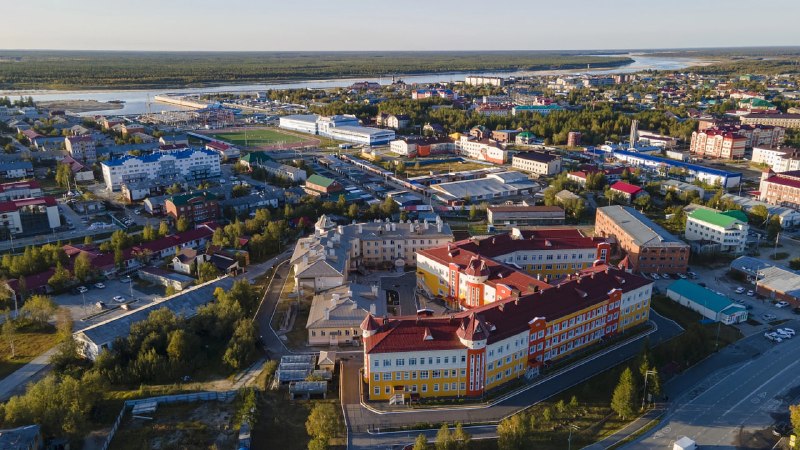
Tarko-Sale (Yamalo-Nenets Autonomous District). 22,000 residents are not small cities." A joint project with the Center for the Study of Small Cities (Ivanovo region). Located near the source of the Fur River, 800 km southeast of Selkard. The name translated from Nnets means "cape at a fork" or "settling between rivers", reflecting the geographical location. The history of Tarco-Sale is different from many cities in the north, which appeared due to the proximity of oil and gas fields. In January 1932, Porovski District was established as part of the Yamello-Nants National District. Tarco Sale was established as a temporary administrative center. Before the war, the center moved twice, but it never happened. The basis of the economy was harvest and harvest. In 1945, the deployed fish farms and groups were merged into the Verkhne-Purovsky State Farm, which today maintains the only farm in the Russian Federation in the Far North. Since 1972, the factory "Dag Magid" has been operating. Until the middle of the 21st century, the only winter transport was poor and dog tracks. In 1957 a hydrodrome was built on Pyakupur. In 1962, the residents built a strip of dirt manually. Now only helicopters fly to Krasnoselkup and Tolka. The oil and gas history of the district began with the discovery in 1965 of the Porphy (Globkin) field. An oil exploration expedition settled in Terco-Sala. But the village itself did not become the drilling center, it remained the headquarters for field teams. In the 80-90s of the 20th century, the first capital buildings appeared. Before everything was built of wood. Until the 1970s, in the central part of the settlement there were epidemics of families who moved to settled life, but kept their normal home. The families were connected to specialists at the district hospital, who helped them adapt to village life.
Tarko-Sale (Yamalo-Nenets Autonomous District). 22,000 residents are not small cities." A joint project with the Center for the Study of Small Cities (Ivanovo region). Located near the source of the Fur River, 800 km southeast of Selkard. The name translated from Nnets means "cape at a fork" or "settling between rivers", reflecting the geographical location. The history of Tarco-Sale is different from many cities in the north, which appeared due to the proximity of oil and gas fields. In January 1932, Porovski District was established as part of the Yamello-Nants National District. Tarco Sale was established as a temporary administrative center. Before the war, the center moved twice, but it never happened. The basis of the economy was harvest and harvest. In 1945, the deployed fish farms and groups were merged into the Verkhne-Purovsky State Farm, which today maintains the only farm in the Russian Federation in the Far North. Since 1972, the factory "Dag Magid" has been operating. Until the middle of the 21st century, the only winter transport was poor and dog tracks. In 1957 a hydrodrome was built on Pyakupur. In 1962, the residents built a strip of dirt manually. Now only helicopters fly to Krasnoselkup and Tolka. The oil and gas history of the district began with the discovery in 1965 of the Porphy (Globkin) field. An oil exploration expedition settled in Terco-Sala. But the village itself did not become the drilling center, it remained the headquarters for field teams. In the 80-90s of the 20th century, the first capital buildings appeared. Before everything was built of wood. Until the 1970s, in the central part of the settlement there were epidemics of families who moved to settled life, but kept their normal home. The families were connected to specialists at the district hospital, who helped them adapt to village life.
🇷🇺 Russia · Map
More on Radar
Want to see every report in real time?
Hundreds of sources worldwide, translated into your language, with alerts for what matters to you.
Sign up free Already have an account? Log in