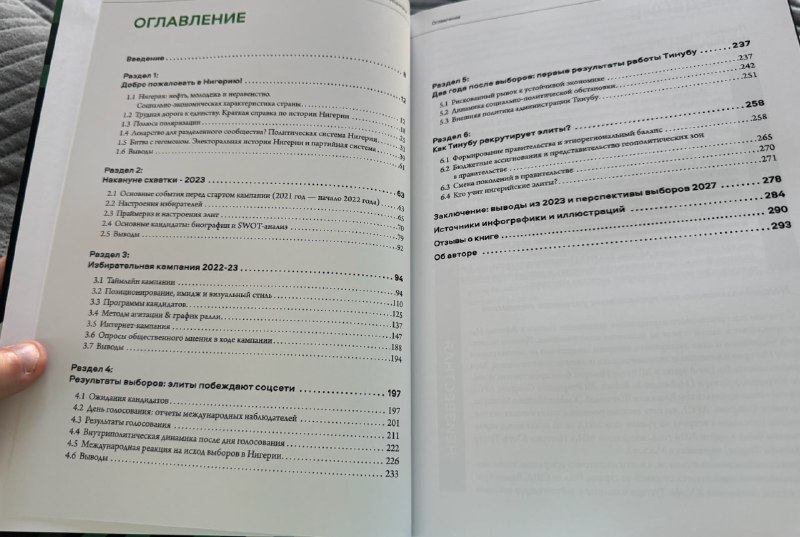
In the summer I was calmly walking down the street when Valentin Bianchi called me). And not only to read, but contributed the book "Politics in Nigeria: Elites and Voters".
I tried to deflect as usual, as I avoid paper books and usually ask for a PDF. Then listen to the audio version at speed 2. But Valentin was determined and gave the paper version.
Then my eldest son took the book from me because of the abundance of illustrations and tables. And while I was looking for time (and then the book itself) to leaf through it, Valentin managed to present the English version in the Nigerian capital, Abuja.
What has already been written is enough for some readers to be surprised by the very existence of a book on modern Nigerian politics in Russian and want to immediately buy it. And others immediately stopped reading the post. For those who remain, I will try to explain why it would be interesting if you and I followed at least a little what is happening in Nigeria. Let's start with demographic humiliation. The population of Nigeria is 242 million. It hurts to some extent the Russian national self-consciousness, that Russia sometimes seems to be in fourth place in the world in terms of population. actually in the ninth. After the obvious: India, China (not to mix places) and the USA, and also Indonesia, Pakistan, Nigeria, Brazil and the more aggressive Bangladesh. Supporting from the bottom are Mexico, Japan, Ethiopia, the Philippines, Congo, Egypt and Vietnam, which crossed 100 million. But despite the growing managerial love for demographics, they are still being overcome.
In all other respects, Nigeria perfectly fits certain stereotypes about Africa and defies others.
Fits the oil wealth stereotype. Nigeria produces about 1.5 million barrels per day and remains the largest oil producer in Africa. Libya, Angola and Algeria are slightly behind. At the same time, petrol here costs about $1 per liter - quite expensive for most Nigerians. There used to be fuel subsidies, but they were removed in 2023.