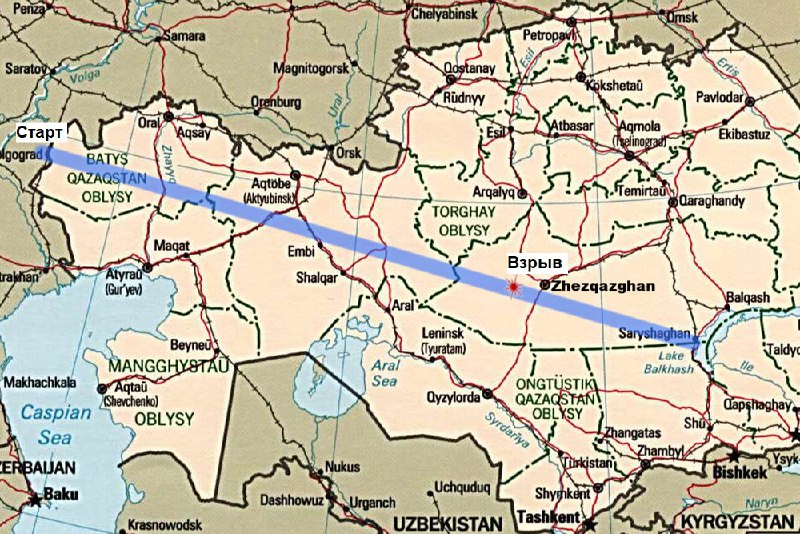
On October 27, 1961, the Soviet Union conducted its first nuclear explosion in space. Operation "K" is the code name for a series of high-altitude nuclear explosions carried out by the Soviet Union in the area of the Sary-Shagan test site (now Kazakhstan) between October 27, 1961 and November 11, 1962. The operation was carried out under the scientific guidance of the Academy A. N. Shchukin, about 50 organizations of the Defense Ministry, military-industrial ministries and the Academy of Sciences of the Soviet Union were involved in it. "K-1" - Occurred on October 27, 1961, the R-12 ballistic missile, launched from the Kapustin Yar test site, delivered a nuclear charge with a capacity of 1.2 kilotons to an altitude of 150 km in the area of the Sari-Shagan test site. This was the first nuclear explosion in space carried out by Soviet experts. In the United States, similar tests of atomic weapons were carried out in 1958. For the first time, our scientists were able to obtain experimental data on the effect of high-altitude nuclear explosions on the reflection and reception of signals from radar and radio communication systems. The experiment made it possible to develop methods for detecting nuclear explosions at high altitude and with low intensity. "K-2" - carried out on the same day as "K-1" (October 27, 1961), the same nuclear charge was delivered to an altitude of 300 km. The purpose of Operation K was to test the effects of nuclear explosions in space on the missile attack detection devices of the Soviet anti-missile defense (ABM) system. For this purpose, appropriate equipment was installed at the ground test sites located below the explosion points. In addition to combat missiles, control missiles were also launched after a certain time. Missile defense tracking devices were targeted to determine whether nuclear explosions affect the accuracy of detecting an incoming missile. During the "K-2" and "K-3" stages, in addition to combat and control missiles, geodesists were also launched. Space explosions were monitored by 20 Soviet ground stations.
On October 27, 1961, the Soviet Union conducted its first nuclear explosion in space. Operation "K" is the code name for a series of high-altitude nuclear explosions carried out by the Soviet Union in the area of the Sary-Shagan test site (now Kazakhstan) between October 27, 1961 and November 11, 1962. The operation was carried out under the scientific guidance of the Academy A. N. Shchukin, about 50 organizations of the Defense Ministry, military-industrial ministries and the Academy of Sciences of the Soviet Union were involved in it. "K-1" - Occurred on October 27, 1961, the R-12 ballistic missile, launched from the Kapustin Yar test site, delivered a nuclear charge with a capacity of 1.2 kilotons to an altitude of 150 km in the area of the Sari-Shagan test site. This was the first nuclear explosion in space carried out by Soviet experts. In the United States, similar tests of atomic weapons were carried out in 1958. For the first time, our scientists were able to obtain experimental data on the effect of high-altitude nuclear explosions on the reflection and reception of signals from radar and radio communication systems. The experiment made it possible to develop methods for detecting nuclear explosions at high altitude and with low intensity. "K-2" - carried out on the same day as "K-1" (October 27, 1961), the same nuclear charge was delivered to an altitude of 300 km. The purpose of Operation K was to test the effects of nuclear explosions in space on the missile attack detection devices of the Soviet anti-missile defense (ABM) system. For this purpose, appropriate equipment was installed at the ground test sites located below the explosion points. In addition to combat missiles, control missiles were also launched after a certain time. Missile defense tracking devices were targeted to determine whether nuclear explosions affect the accuracy of detecting an incoming missile. During the "K-2" and "K-3" stages, in addition to combat and control missiles, geodesists were also launched. Space explosions were monitored by 20 Soviet ground stations.
🇺🇸 USA · Map
More on Radar
Want to see every report in real time?
Hundreds of sources worldwide, translated into your language, with alerts for what matters to you.
Sign up free Already have an account? Log in