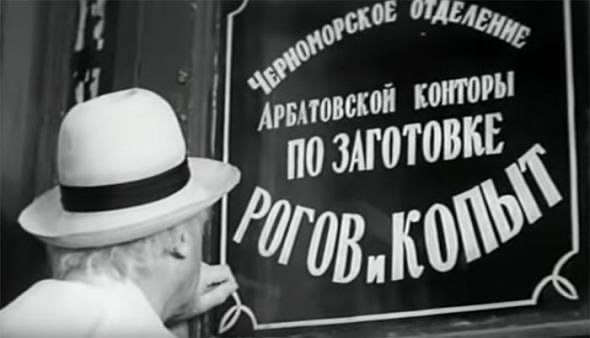
From the "Golden Calf" of Egal and Petrov, the phrase "Ministry of the Horn and the Roses" entered in Russian. It is still called an existing institution on paper, there is a sign, a seal and a staff, but it is impossible to understand what it does. Ostap Bender opened his office for his own purposes, and readers of 1931 were well aware of the familiar Soviet reality. However, there is a story that such an organization appeared outside the novel, and with a much bolder profile of activity. It's called the All-Union Trust for the Exploitation of Meteorite Metals. This story of trust is preserved in the memoirs of the American engineer Zara Witkin, who worked in the Soviet Union in 1934-1932. One evening, his partner was the editor of Crocodile, whom Witkin calls Belsky, and he told about an unusual experiment. A group of colonists decided to find out how many Soviet economic institutions relied on properly designed paper, and received Lazar Kaganovich's approval. The first hurdle was printing. It was not possible to make a seal for a non-existent institution, so the experiments for three days in a row printed a message in the Moscow evening about the loss of the seal of trust, and then they came to the workshop with newspaper clippings and asked to make a duplicate. Delete it. An organization that never existed was never a true seal. Then there were forms, in which the heads of the trust were listed figures of Russian classics, and letters to organizations with the offer of metals extracted from meteorites. Separately it was reported that the trust knows in advance where and when the heavenly bodies will fall in Central Asia. Businesses responded. Amin Furniture volunteered to supply the office, the car offered cars for future supply, and the trust of the gramophone industry, to treat the participants of the expedition, promised to provide them with gramophones and records to illuminate the difficult desert life.
From the "Golden Calf" of Egal and Petrov, the phrase "Ministry of the Horn and the Roses" entered in Russian. It is still called an existing institution on paper, there is a sign, a seal and a staff, but it is impossible to understand what it does. Ostap Bender opened his office for his own purposes, and readers of 1931 were well aware of the familiar Soviet reality. However, there is a story that such an organization appeared outside the novel, and with a much bolder profile of activity. It's called the All-Union Trust for the Exploitation of Meteorite Metals. This story of trust is preserved in the memoirs of the American engineer Zara Witkin, who worked in the Soviet Union in 1934-1932. One evening, his partner was the editor of Crocodile, whom Witkin calls Belsky, and he told about an unusual experiment. A group of colonists decided to find out how many Soviet economic institutions relied on properly designed paper, and received Lazar Kaganovich's approval. The first hurdle was printing. It was not possible to make a seal for a non-existent institution, so the experiments for three days in a row printed a message in the Moscow evening about the loss of the seal of trust, and then they came to the workshop with newspaper clippings and asked to make a duplicate. Delete it. An organization that never existed was never a true seal. Then there were forms, in which the heads of the trust were listed figures of Russian classics, and letters to organizations with the offer of metals extracted from meteorites. Separately it was reported that the trust knows in advance where and when the heavenly bodies will fall in Central Asia. Businesses responded. Amin Furniture volunteered to supply the office, the car offered cars for future supply, and the trust of the gramophone industry, to treat the participants of the expedition, promised to provide them with gramophones and records to illuminate the difficult desert life.
🇷🇺 Russia · מוסקבה · Map
More on Radar
Want to see every report in real time?
Hundreds of sources worldwide, translated into your language, with alerts for what matters to you.
Sign up free Already have an account? Log in