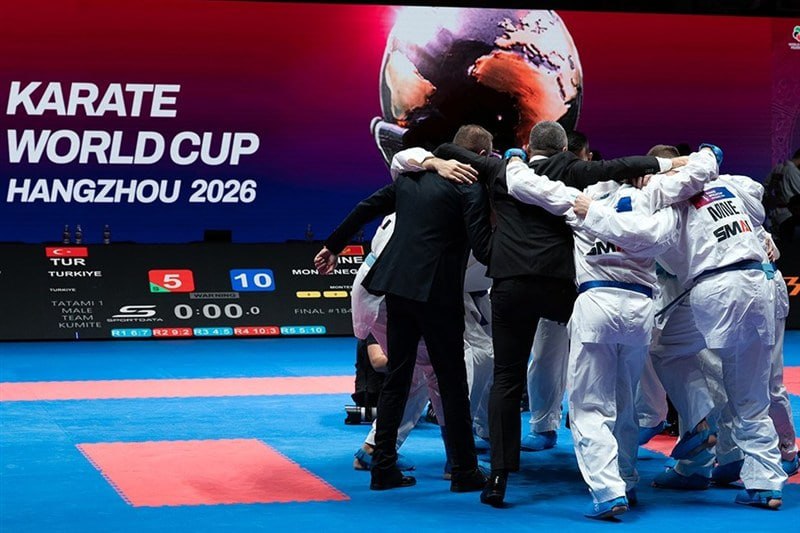
Karate World Cup in the Circle of Change; Japan is stable, Iran is far from the platform.
The second round of the Karate World Cup competitions ended yesterday in Hangzhou, China, while Japan won three championships and Montenegro made history, and comparing the results of this round with the Pamplona 2024 competition indicates a significant change in the composition of the medal-winning teams.
Of the 12 medal-winning positions in this period, only four teams managed to get on the podium in Hangzhou; A figure that, together with the continued dominance of Japan, indicates the transfer of most of the medal winners of the first round in the World Cup.
The performance of the Iranian teams in the second round of the Team Karate World Cup, unlike the first round, ended without winning a medal; Of course, the attendance conditions and the course of the competitions of the four divisions were not the same for our country, and it is not possible to evaluate all the results with the same criteria.
In the men's team scrimmage, Iran actually did not have a team in Hangzhou, but in the women's team scrimmage, Iran, which came eighth in the first round of the World Cup in Pamplona, this time with a complete team change, won fourth place. After passing the group stage and winning against Portugal, the runner-up of the last round, our national team reached the semi-finals at the quarter-final stage, but lost to Egypt and lost to the host China in the qualification match to settle for fourth place.
The promotion of the Iranian women's national team's kata position from 8th to 4th place was a sign of the performance progress in the first round of the World Cup; However, in the end, it did not lead to a medal win. The distance between the Iranian team and the podium decreased during this period, but turning this process into a result of winning medals will require continuity in the preparation program and stabilization of the team's performance in the upcoming competitions.
In the women's team committee, Iran did not participate in the first round and this time entered the competition with a young team. Our country's national team was placed in a difficult group, and also the absence of Atusa Gulshedanjad, the star of the Iranian karate team, was one of the important points in the national team's composition. Despite the effort in the group stage, the Iranian team failed to reach the quarter-final stage and was unable to continue in the competition. A result that must be evaluated considering the conditions of the lineup and the level of the competitors.
In the men's team committee the situation was different.