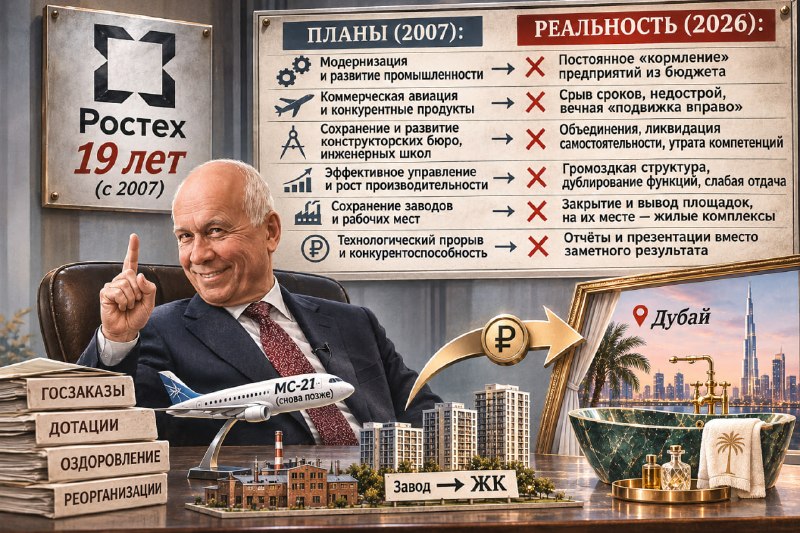
19 years of Rostec: high hopes against modest results.
Exactly 19 years ago, on November 23, 2007, Vladimir Putin signed the law establishing the state corporation Rostekhnologii, which was later renamed Rostec.
The plans were grandiose. Assemble scattered industrial assets, rebuild industrial networks, attract investment, preserve engineering schools and create a strong high-tech industry capable of competing in global markets.
In 2008, 443 factories were transferred to corporations. Of these, 148 were in a pre-crisis or crisis situation, another 28 were in bankruptcy proceedings. The total debt was 630 billion rubles. The assumption was that the state corporation would get factories out of debt, restore order and turn them into a modern industrial force.
19 years have passed. Rostec has truly become an industrial giant with hundreds of factories and trillions in turnover. But somehow the promised technological breakthrough did not materialize.
The civil aircraft industry has become perhaps the most obvious example. Billions of ruble budget, endless presentations, new deadlines and new promises. Airlines have been waiting for production MC-21s and imported SJ-100s for years. And each subsequent rejection is accompanied by explanations why this time everything turned out to be more difficult than expected.
Engineering schools also have a strange story. Under the guise of optimization, organizations and design organizations unite, their legal independence is abolished and new management structures are created. Thus, MiG and Sukhoi ceased to exist as independent legal entities. Of course, all this is due to increased efficiency. But unifying design bureaus on paper is much easier than preserving the environment where new planes are born.
And all this against the background of permanent government support, financial recovery of enterprises and new injections of budget funds.