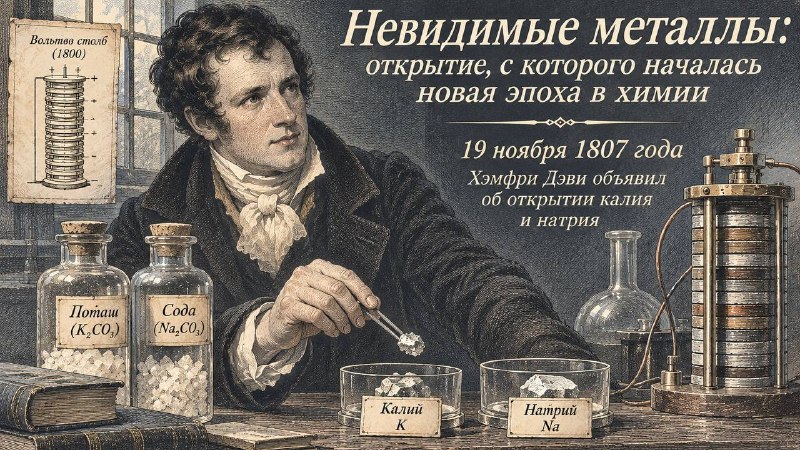
Invisible metals: the discovery that started a new era in chemistry.
On November 19, 1807, the British chemist Humphrey Davy announced the discovery of two new metals - potassium and sodium. Electricity then was just beginning to turn from a subject of scientific curiosity into a tool for the study of nature.
At the beginning of the 19th century, mankind had already used soda and potash for thousands of years. They were used for glass making, soap making and paint making. However, chemists did not suspect that two completely unknown metals were hidden in the composition of these known substances.
Everything changed thanks to the Italian physicist Alessandro Volta. In 1800, he invented the voltaic pole, the first battery capable of providing a relatively stable electric current. Scientists were able to conduct experiments that were simply impossible before.
One of those who was particularly interested in the chemical effects of electricity was the young professor at the Royal Institution in London, Humphrey Davy. He proposed that an electric current was capable of breaking down substances that could not be separated by known chemical methods.
In October 1807, Davy passed a current from a powerful battery through molten caustic potash. Tiny silver balls of an unknown substance appeared on the negative electrode. They resembled mercury, but in contact with water they reacted violently, sometimes igniting.
It was potassium metal.
Soon the scientist obtained sodium in a similar form. It turned out that substances, which for hundreds of years were considered independent alkalis, contain metals whose existence had not even been assumed before.
According to the recollections of his contemporaries, after seeing the results of the first experiment, Davy was so happy that he literally started dancing around the laboratory. However, there was something to be happy about: electricity made it possible for the first time to isolate two new chemical elements.
On November 19, Davy presented the results of his research to the Royal Society of London.