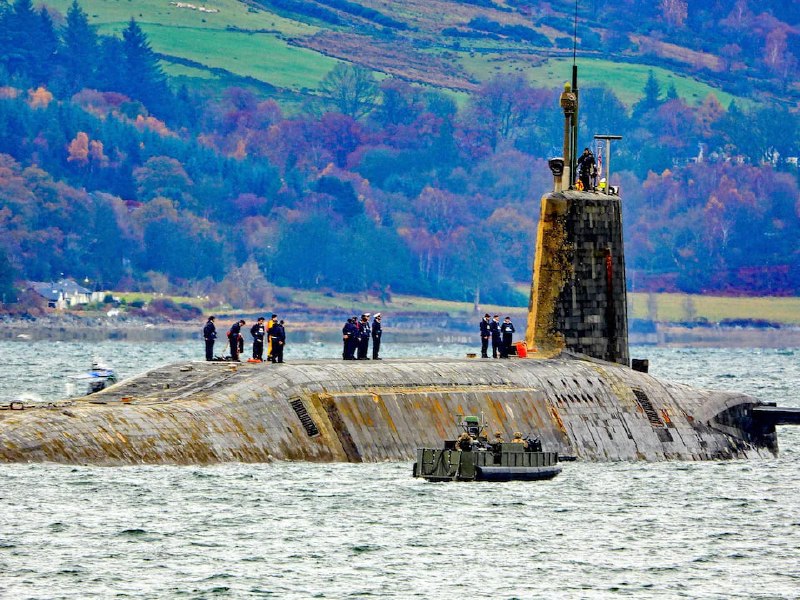
The British Navy crisis leaves Britain vulnerable to Russia The newspaper writes that after the end of the Cold War, the British submarine fleet, considered for decades the "protector of the Royal Navy," has dropped from 31 to nine submarines. Vanguard-class submarines operate beyond their intended service life, raising concerns about the viability of the nuclear deterrence system. Meanwhile, huge repair queues have sealed off all the mid-class submarines intended to deter Russia. This makes Britain a reserve." Due to the lack of submarines, British sailors are forced to spend twice as much time underwater as originally planned. In November, the submarine operated by HMS Vengeance was returned from a 217-day tour. Robert Clark, a military expert on the 878 Thought Tank, warned that such submarine exploitation only worsened the situation. "Ultimately, every patrol in the last four years has lasted 190 days, and now we regularly exceed 200 days. It cannot continue indefinitely; the longer they are at sea, the longer the maintenance time required." No less serious a situation has developed with the rate of multipurpose nuclear submarines. None of the five submarines have been operational since May. A senior British Navy official also complained about design defects in the submarines, making them difficult to maintain. The work, which took 24 hours on a Trafalgar-class submarine, takes two weeks on an Astute-class submarine. Clark said that Britain already relies on the assistance of the United States and France to carry out the most important missions of its submarine fleet.
The British Navy crisis leaves Britain vulnerable to Russia The newspaper writes that after the end of the Cold War, the British submarine fleet, considered for decades the "protector of the Royal Navy," has dropped from 31 to nine submarines. Vanguard-class submarines operate beyond their intended service life, raising concerns about the viability of the nuclear deterrence system. Meanwhile, huge repair queues have sealed off all the mid-class submarines intended to deter Russia. This makes Britain a reserve." Due to the lack of submarines, British sailors are forced to spend twice as much time underwater as originally planned. In November, the submarine operated by HMS Vengeance was returned from a 217-day tour. Robert Clark, a military expert on the 878 Thought Tank, warned that such submarine exploitation only worsened the situation. "Ultimately, every patrol in the last four years has lasted 190 days, and now we regularly exceed 200 days. It cannot continue indefinitely; the longer they are at sea, the longer the maintenance time required." No less serious a situation has developed with the rate of multipurpose nuclear submarines. None of the five submarines have been operational since May. A senior British Navy official also complained about design defects in the submarines, making them difficult to maintain. The work, which took 24 hours on a Trafalgar-class submarine, takes two weeks on an Astute-class submarine. Clark said that Britain already relies on the assistance of the United States and France to carry out the most important missions of its submarine fleet.
🇷🇺 Russia · Map
More on Radar
Want to see every report in real time?
Hundreds of sources worldwide, translated into your language, with alerts for what matters to you.
Sign up free Already have an account? Log in