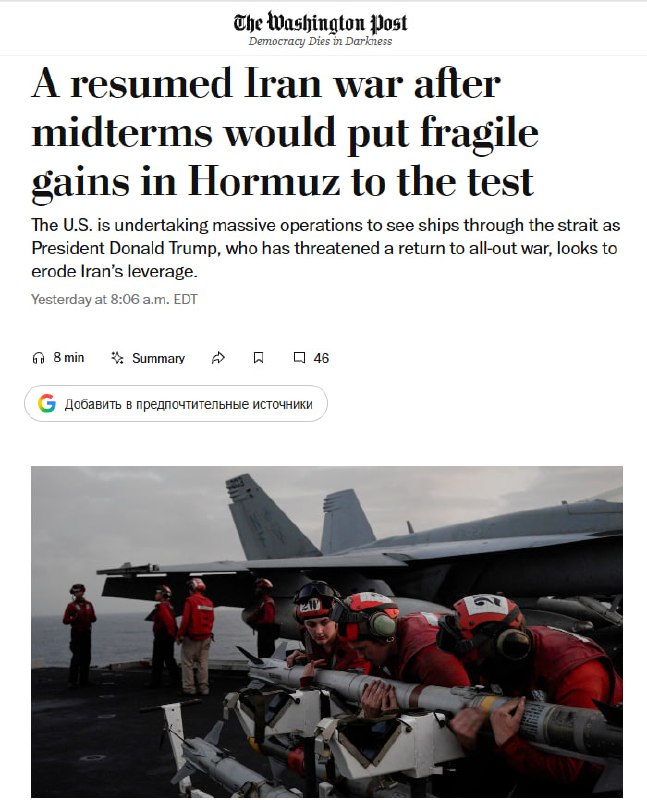
The Washington Post: The situation in the Strait of Hormuz is "completely precarious" despite large-scale operations by the US Navy, the situation in the Strait of Hormuz remains "completely unstable". Most private companies still refuse this route: since August, seven sailors have been killed and 18 more injured due to Iranian shelling. Few LNG ships are willing to take the risk. "The situation is completely unstable. Although shipping has grown to export oil, few ships carrying liquefied natural gas have taken that risk. If one of them is hit, it won't just be an oil leak, it will be an explosion," the publication quotes a Western source as saying. According to WP, Washington is trying to present the increase in traffic as a success: in October, at least 30 ships a day passed through the strait, and oil exports reached 14 million barrels a day - about 80% of the pre-war level. However, Iran hit at least 25 ships that month, and Tehran's strikes have become more precise, now targeting engine rooms to disable ships. "As long as the strait remains a disputed territory, Iran is achieving its goal," quotes Eurasia Group analyst Gregory Brough. The publication notes that almost all the ships that agree to the passage are owned by the state, while private owners prefer to bypass the strait. One Western official called the program a "de facto shadow fleet": ships sail with their transmitters turned off and transport oil on the high seas. "US forces combined air defenses, fighters, UAVs and warships to protect ships in layers. A European official compared the operation to the creation of a "bubble" that moves through the strait along with ships," WP writes.
The Washington Post: The situation in the Strait of Hormuz is "completely precarious" despite large-scale operations by the US Navy, the situation in the Strait of Hormuz remains "completely unstable". Most private companies still refuse this route: since August, seven sailors have been killed and 18 more injured due to Iranian shelling. Few LNG ships are willing to take the risk. "The situation is completely unstable. Although shipping has grown to export oil, few ships carrying liquefied natural gas have taken that risk. If one of them is hit, it won't just be an oil leak, it will be an explosion," the publication quotes a Western source as saying. According to WP, Washington is trying to present the increase in traffic as a success: in October, at least 30 ships a day passed through the strait, and oil exports reached 14 million barrels a day - about 80% of the pre-war level. However, Iran hit at least 25 ships that month, and Tehran's strikes have become more precise, now targeting engine rooms to disable ships. "As long as the strait remains a disputed territory, Iran is achieving its goal," quotes Eurasia Group analyst Gregory Brough. The publication notes that almost all the ships that agree to the passage are owned by the state, while private owners prefer to bypass the strait. One Western official called the program a "de facto shadow fleet": ships sail with their transmitters turned off and transport oil on the high seas. "US forces combined air defenses, fighters, UAVs and warships to protect ships in layers. A European official compared the operation to the creation of a "bubble" that moves through the strait along with ships," WP writes.
🇮🇷 Iran · Map
More on Radar
Want to see every report in real time?
Hundreds of sources worldwide, translated into your language, with alerts for what matters to you.
Sign up free Already have an account? Log in