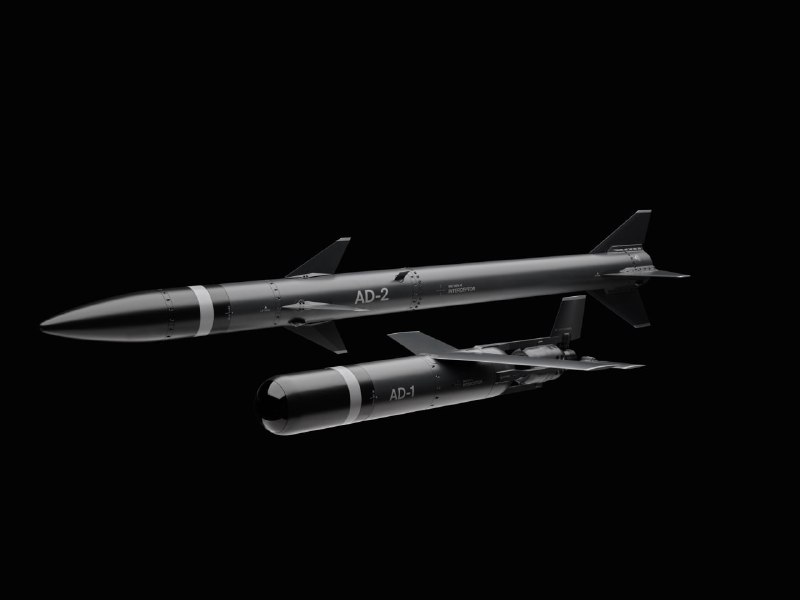
A German company has introduced an air defense system based on artificial intelligence. The manufacturer claims its high efficiency and cost-effectiveness. Helsing developed the Contra air defense system, which uses artificial intelligence to track aerial targets, prioritize their destruction and launch ground interceptors. The system uses two types of interceptors: AD-1 Hell is a jet UAV capable of patrolling the airspace, operating as part of a swarm and re-attacking targets; AD-2 Ambush is a solid-propellant rocket with a speed of up to Mach 2.5 and a range of more than 20 km. Both interceptors are launched from containers. In the middle part of the route they are guided by ground radar stations, and in the last part - by their own radar heads. According to the developers, the system is capable of hitting targets at a height of up to 10 km in all weather conditions. Contra also makes it possible to integrate equipment from other manufacturers, including lasers, anti-aircraft and drone interception systems with networks, within a few days. Helsing claims that the cost of the interceptors will be significantly lower than the existing analogues, but has not yet revealed specific prices. "Contra will end the air defense dilemma: slow drones in fair weather or million-euro missiles against cheap mass targets," said company president Niklas Kohler. The company explains the development of the system in the growing threat of mass use of UAVs. Helsing estimates, based on intelligence data, that Russia's Geranium-4 and Geranium-5 UAV production has reached 4,000 units per month.
A German company has introduced an air defense system based on artificial intelligence. The manufacturer claims its high efficiency and cost-effectiveness. Helsing developed the Contra air defense system, which uses artificial intelligence to track aerial targets, prioritize their destruction and launch ground interceptors. The system uses two types of interceptors: AD-1 Hell is a jet UAV capable of patrolling the airspace, operating as part of a swarm and re-attacking targets; AD-2 Ambush is a solid-propellant rocket with a speed of up to Mach 2.5 and a range of more than 20 km. Both interceptors are launched from containers. In the middle part of the route they are guided by ground radar stations, and in the last part - by their own radar heads. According to the developers, the system is capable of hitting targets at a height of up to 10 km in all weather conditions. Contra also makes it possible to integrate equipment from other manufacturers, including lasers, anti-aircraft and drone interception systems with networks, within a few days. Helsing claims that the cost of the interceptors will be significantly lower than the existing analogues, but has not yet revealed specific prices. "Contra will end the air defense dilemma: slow drones in fair weather or million-euro missiles against cheap mass targets," said company president Niklas Kohler. The company explains the development of the system in the growing threat of mass use of UAVs. Helsing estimates, based on intelligence data, that Russia's Geranium-4 and Geranium-5 UAV production has reached 4,000 units per month.
🇾🇪 Yemen · מארב · Map
More on Radar
Want to see every report in real time?
Hundreds of sources worldwide, translated into your language, with alerts for what matters to you.
Sign up free Already have an account? Log in