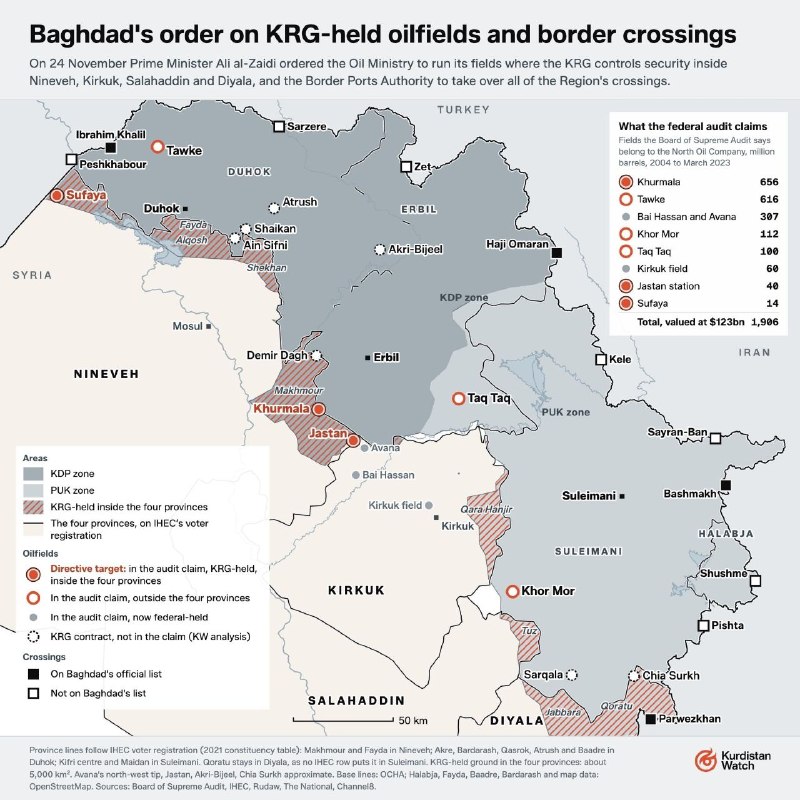
🇮🇶️The Iraqi prime minister's moves are widely seen in the Kurdistan region as the first step in a broader, multi-step process. They are also seen as a slippery slope: if the KRG accepts these steps, many more will follow.
This explains the KDP and PUK's joint push to resist, as the process seeks to reduce the power of both parties. Here's how they figure it out:
1. The decision is seen as strategically calculated as it first targets oil fields in Kirkuk, Nineveh, Diyala and Salah al-Din, where Baghdad has a stronger constitutional argument. These fields are outside the established administrative boundaries of the Kurdistan Region, giving the federal government a firmer basis to claim ownership and control. The KRG, however, claims they are in the disputed territories, along with many other areas now under federal control, whose status remains constitutionally unresolved.
2. Even if Baghdad takes control of only the fields listed in today's directive, Harmala and some smaller fields will remain under KRG control. Together they account for roughly half of the KRG's oil output, which already stands at just 200,000 barrels per day.
3. As we reported a few days ago, Iraq's audit authority is also keeping an eye on other KRG fields, such as Tok, also within Duhok province, Tak, also within Erbil, and Khor Mor, also within Sulaimani. Today's directive does not cover these, but Baghdad may push to take them over at a later stage.
4. Placing the border crossings under the Iraqi Border Authority would deprive the KRG of most of its non-oil revenues and control of its trade, a key geopolitical tool. Its regional role will weaken significantly.
The directive also orders the closure of all unofficial border crossings. This covers about 80% of the KRG's crossings, as only four are officially recognized. Samlaka, the KRG's only crossing with Syria, played a key role during the Syrian government's attack on SDF areas, but under this directive it will have to close. The cost extends beyond revenue to the region's geopolitical role.
5. Once these independent revenue streams dwindle, Baghdad reportedly wants to push, in the coming months or even weeks, to more than halve the KRG's security forces, which currently number more than 400,000 of the region's 1. 2 million employees in the public sector. Baghdad's regional wage funding gives it considerable leverage in this regard.
6. Other moves include a push to cancel the Ministry of Peshmerga Affairs. The argument is that the Peshmerga are an Iraqi regional guard force that must sit within the Iraqi command structure, so they cannot have a separate office.
7. Another step would be to close all KRG missions abroad and the KRG's foreign relations department. The Iraqi constitution allows the KRG an office within Iraqi embassies, but without a separate and independent representation.
8. Another step would be federal control of airports, in addition to border crossings, ending the KRG's separate visa and residency regime.
📎 Kurdistan clock.