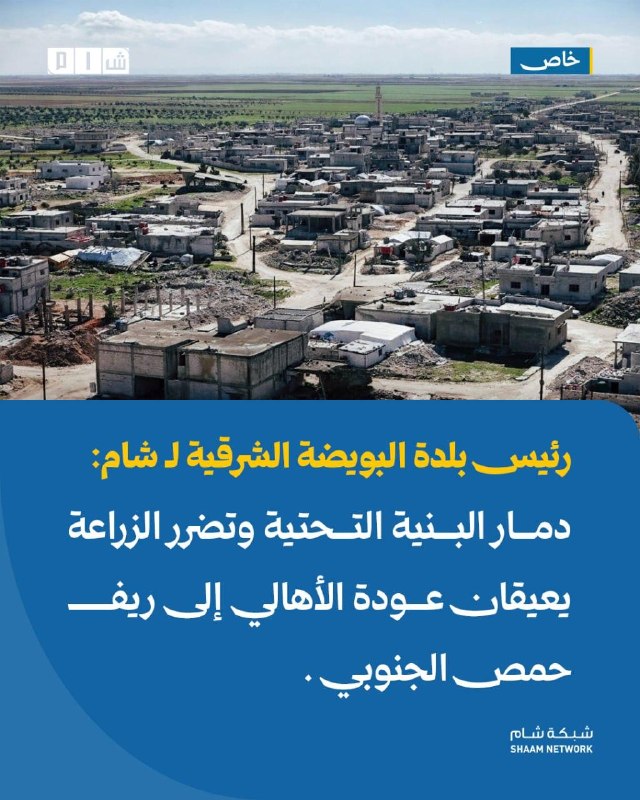
◂ The head of the town of al-Boyida al-Sharqiya in southern Homs, engineer Arif Muhammad Satuf, confirmed in an interview with the "Sham News" network that the village was subjected to comprehensive and systematic destruction at the hands of Assad's gangs because of its support for the revolution, which led to the displacement of 13 of its residents.
◂ Satoff explained that about 1,400 families have returned to the ruins of their homes since the dawn of liberation from Lebanon, Jordan and northern Syria, where more than 100 families still live in plastic tents, while others were forced to sell their land to finance reconstruction work amid the destruction of the obstacles.
◂ Satoff reviewed the reality of the dilapidated sewer network as a result of the bombing, and pointed out the inability of the old technical cistern to serve the village and the flooding of water towards agricultural lands and residences, which makes the rehabilitation and maintenance of its network the forefront of urgent projects.
◂ Satoff pointed out a severe shortage of electric poles and electric wires, and that over 20% of the village remained without electricity, with the need for an additional transformer, in addition to the existence of leak points in the drinking water network inside the destroyed houses, and the need in other neighborhoods to extend new lines.
◂ Satoff explained that the village's roads suffer from the spread of potholes, and most of the asphalt and dirt streets need maintenance and rehabilitation as a result of barrel bombs, and added that the residents are demanding a license to establish a catering bakery that will serve more than seven thousand people to compensate for the severe shortage.
◂ Satoff revealed that the Ministry of Emergencies and Disasters continues to transport about 30,000 square meters of rubble after the municipality previously transported 35,000 square meters, at the same time as maintaining 100 m of sewers, and noted that the deterioration of the services and the inability of the people to repair are preventing the return of about 2,000 families.
◂ Satoff pointed to the deterioration of living conditions after Assad's gangs cut down olive and almond trees and filled private irrigation wells, which caused residents to lose their main source of livelihood in agriculture and caused some of them to sell their land to repair their homes.
◂ Satoff explained that the random sorting of the properties by the previous regime caused disputes between families over land borders following their return, and emphasized that the municipality is working to find solutions by agreement to reduce these disputes.