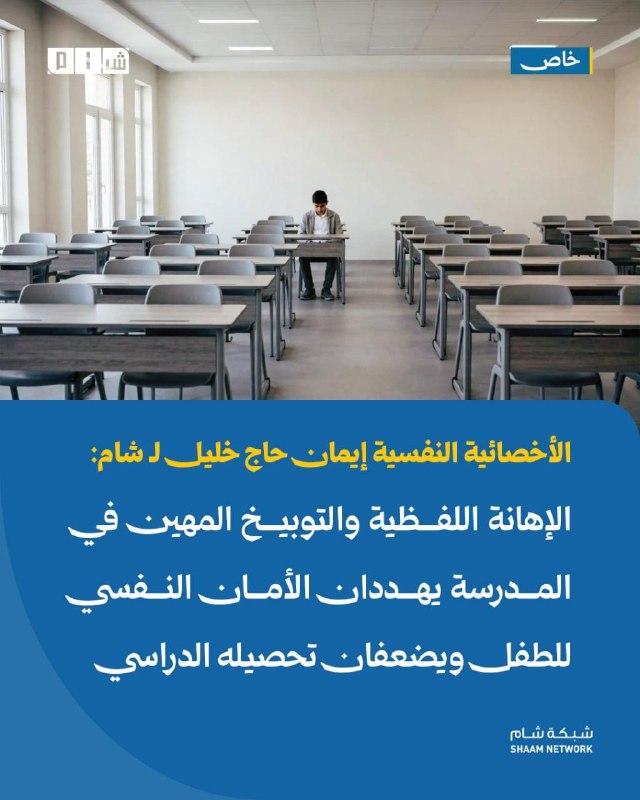
◂ Psychologist Iman Haj Khalil confirmed in an interview with the Duma News network that repeated verbal insults and humiliating reprimands are a form of psychological abuse that affects the emotional, social and cognitive development of the child, especially in the early stages of life when he is building his self-esteem and perceptions of the world around him.
◂ Haj Khalil explained, based on Erik Erikson's theory of the conflict of "effort versus feelings of inferiority", that the child seeks during school to prove his abilities and gain the appreciation of his teachers, but his repeated exposure to ridicule and negative descriptions creates in him a sense of inferiority of real behavior that needs existence and incompetence.
◂ She showed that harsh treatment weakens the student's sense of psychological security, which is considered a basic need according to Abraham Maslow's theory, and warned that turning the teacher into a source of threat turns the school into an environment of anxiety and expectation, where the child is more concerned with avoiding embarrassment and punishment than with learning and in the classroom.
◂ She stated that verbal abuse weakens the educational relationship based on trust and respect and pushes the student to avoid communication with his teacher. Its effects also extend to his relationships with his peers according to Albert Bandura's social learning theory, as some children may imitate the aggressive behavior of the teacher, while others tend to isolate and withdraw socially.
◂ Haj Khalil pointed out that high stress resulting from repeated intimidation affects the functions of the prefrontal cortex, which is responsible for attention, working memory and planning, citing scientific studies that confirm the connection of verbal abuse by teachers with poor participation in the classroom, a decrease in motivation and the appearance of academic and behavioral difficulties.
◂ I explained, in light of the theory of self-efficacy, that mocking a student in front of his peers weakens his confidence in his ability to succeed and makes him afraid of making mistakes, so he resorts to silence and avoids asking questions or expressing his opinion, while emphasizing the need to distinguish between educational behavior and the ability to respect the student properly.
◂ I mentioned that the psychological and behavioral effects of verbal violence vary according to the age of the child and the severity of the abuse, and appear psychologically through anxiety, sadness and a sense of inferiority, and behaviorally through introversion, irritability and aggression, in addition to avoiding going to school or dropping out suddenly.