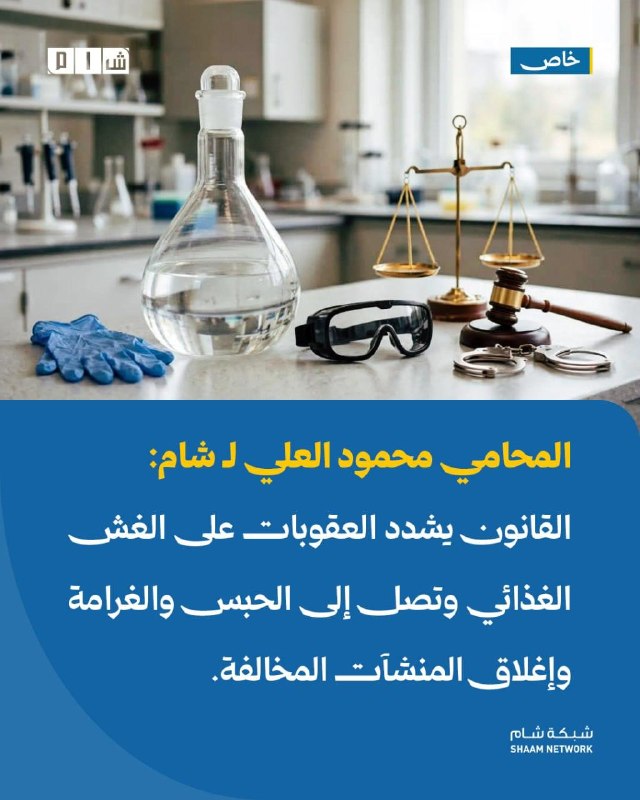
◂ Lawyer Mahmoud Al-Ali confirmed in an interview with Dumma News Network that the legislator addressed cases of food and grain fraud in accordance with Legislative Decree No. 8 of 2021, which includes the Consumer Protection Law, in a way that guarantees protection of consumer rights, food safety and product quality control.
◂ Al-Ali explained that the law included provisions to protect the consumer from food fraud or violation of approved standard specifications, which indicates that the standard specification is a document issued by the relevant public authority detailing the requirements of the material, its instructions and its nutritional characteristics.
◂ He added that these specifications include methods for analysis, storage, packaging and taking samples from food, in addition to the requirements for the declaration card and technical terms related to national specifications that conform to international standards.
◂ Al-Ali stated that the criminal and civil legal responsibility is not limited to the person who produced the food or added the harmful substance to it, but applies to anyone who puts the fake food up for sale, presents it or sells it while knowing about the fraud or corruption.
◂ He pointed out that the legislator assumed knowledge of fraud or corruption for a violator engaged in the food industry or food trade, in accordance with the provisions of section 53 of the Consumer Protection Law, which made the punishment worse in the case of the use of toxic substances or those harmful to public health.
◂ Al-Ali explained that the second paragraph of Article 53 intensified the punishments in the event that the counterfeit materials are corrupt or harmful to human health, reaching a prison term of at least two years and a fine of 10 million Syrian pounds, with the closure of the facility or store for a period not exceeding six months.
◂ He stated that eating contaminated food, if it results in the consumer suffering from poisoning, illness or physical injury, involves civil liability requiring compensation for material, physical and moral damages, provided that the occurrence of the damage and its connection to the act committed can be proven.
◂ Al-Ali emphasized that the manufacturer or the seller is not exempted from responsibility just by claiming that he was not aware of the presence of the harmful substance in the food product, which indicates that the duty to ensure the safety of the food rests first and foremost on the factors responsible for its production and circulation.
For more information:
"S.N.N | Dummy Network".