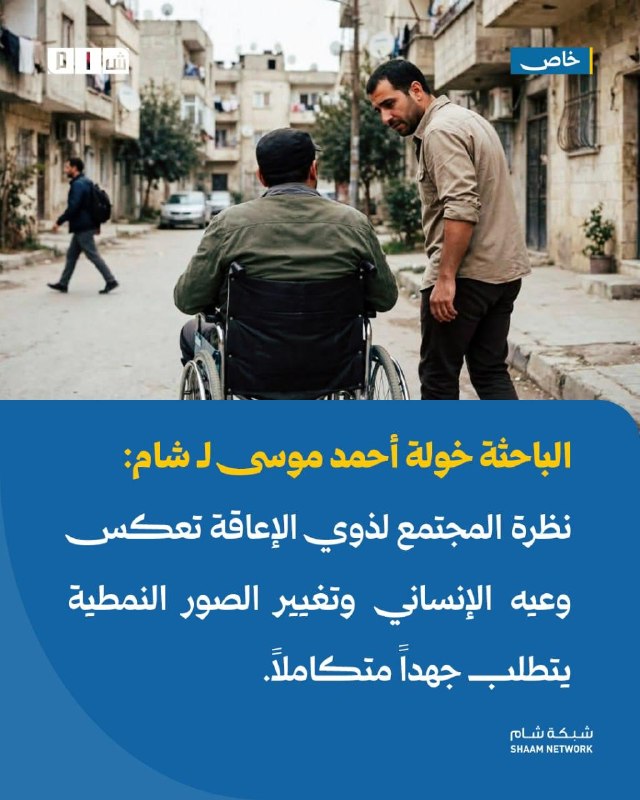
◂ Khola Ahmed Musa, a researcher in the field of special education, said in an exclusive interview to "Sham" that society's perception of people with disabilities reflects the level of cultural and humanitarian awareness and its ability to embrace diversity without exclusion, noting that the issue gains double sensitivity in Syria as a result of the intersection of the traditional transformations that have expanded.
◂ Musa explained that the most prominent stereotypes are to treat a person with a disability as helpless and completely dependent on others, or to present him as a superhero and his accomplishments, or to limit him to the image of a permanent victim, in addition to including the effect of the physical disability on his mental and social abilities.
◂ Moussa noted that the lack of direct and realistic communication in schools and workplaces reinforces this stereotypical view, in addition to linguistic heritage and unprepared environments that limit their appearance in the public sphere, and media representation that limits them to charitable or tragic contexts without emphasizing their natural roles.
◂ Musa showed that constant pity and overprotection undermine the independence of a person with a disability and push him to doubt his abilities and deny him the right to experiment, and he emphasized that overt and hidden discrimination increases feelings of loneliness and low self-image and reduces the chances of creating an equal partnership and marriage.
◂ Musa emphasized that changing stereotypes begins in the family by raising children for acceptance, strengthening the independence of people with disabilities and integrating them into daily responsibilities in a positive language, and extends to school through inclusive education, fighting bullying and including the values of diversity in educational activities.
◂ Musa emphasized the importance of presenting people with communication disabilities in the contexts of everyday and professional life in terms that respect their dignity, and called on institutions and society to increase their integration by including them in decision-making and designing plans and policies instead of planning for them in isolation.
For more:
"S.N.N | Dummy Network".