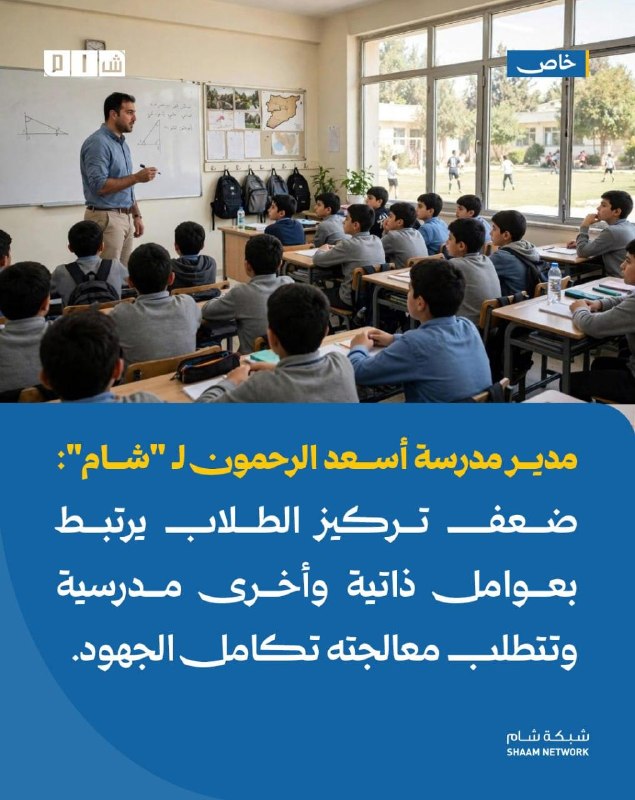
◂ The principal of a school in the town of Talmans, Asad Al-Rahman, explained in an exclusive interview to "Sham" that the reasons for the students' poor concentration are divided between factors internal to the student and others related to the school environment.
◂ Al-Rahman explained that the subjective factors include lack of sleep, malnutrition, neglecting breakfast, family and psychological problems and learning difficulties, while the school factors include rigid teaching methods, lesson length, poor classroom management, noise and poor ventilation.
◂ Al-Rahman noted that the classroom environment directly affects mental performance. Crowding increases visual and auditory distraction, noise accelerates mental fatigue, poor ventilation and high temperature cause fatigue, and inappropriate lighting leads to eye strain and headaches.
◂ Al-Rahman pointed out that prolonged indoctrination and explanation make the student a passive recipient and contradict the nature of the mind, which loses focus after 10 to 15 minutes, causes boredom and daydreams and weakens critical thinking and interaction in the classroom.
◂ Elrahmon stated that a careful observation of two basic indicators differentiates the source of the problem; The appearance of absent-mindedness among a group of students at one time is related to the classroom environment or the teaching method, while its continuation in a particular student with introversion or fatigue is related to health or family situations that require the intervention of the counselor.
◂ Al-Rahman emphasized that increasing attention requires combining the efforts of the teacher and the administration by diversifying teaching strategies, dividing the class, using active learning and introducing quick motor or mental activities for two minutes to break the stagnation and rejuvenate the activity.
◂ Al-Rahman called for training the class by ensuring ventilation, good lighting and seating arrangements, and emphasized the importance of positive reinforcement through open questions and feedback, and continuous communication with the educational advisor and parents to follow up on individual cases.
For more:
"S.N.N | Dummy Network".