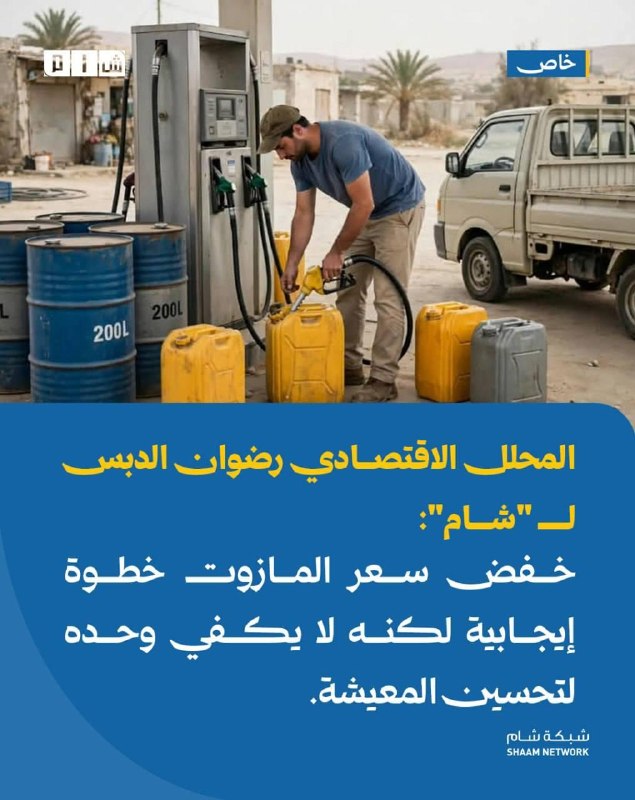
Economic analyst Radwan Al-Dabbs told "Dama": reducing the price of diesel is a positive step, but it is not enough on its own to improve living conditions.
Details:
Economic analyst Radwan Al-Dabbs said, in an interview with Dama News Network, that the reduction in diesel prices is a positive step to ease some of the burden on the productive sectors, but it comes at a time when the Syrian economy needs broader measures to deal with rising costs and improve living conditions.
Al-Dabbs explained that diesel is involved in various stages of economic activity, from operating agricultural machinery and industrial facilities to transporting raw materials and distributing goods. He pointed out that a reduction of 14.3 percent does not necessarily mean a tangible improvement in the lives of citizens in light of the continued increase in other costs and the decrease in purchasing power.
Al-Dabbs noted that the sectors that benefit the most from the decision are agriculture, industry and transportation due to their direct dependence on diesel, and explained that the discount reduces the costs of operating irrigation pumps, agricultural machinery, generators and industrial production lines, in addition to reducing the cost of transporting goods between the provinces.
Al-Dabbs noted that the decrease in agricultural and industrial production and transportation costs should gradually be reflected in the final cost of the goods if the savings are transferred to the marketing and distribution stages. However, the cost of the final product is also affected by raw materials, wages, electricity, the exchange rate and import costs.
Al-Dabbs pointed out that the markets face a challenge related to the slow transfer of discounts to the consumer compared to the speed of price increases, as some traders and manufacturers may benefit from reducing fuel to increase their profit margins, which requires monitoring the markets and examining competition mechanisms to ensure that the savings reach the citizens.
Debs called for reaching a balance in the pricing of oil derivatives by adopting the real cost of insurance and taking into account international oil prices and the exchange rate, and adopting a pricing policy that takes into account the different uses of diesel fuel and takes into account the needs of agriculture and industry, while protecting low-income groups.
Al-Dabbs emphasized that the effect of the reduction is related to the availability of diesel in the markets at the official price and not just the value of the discount that was announced, and calls for guaranteeing the stability of the supply, controlling the distribution activity, fighting monopoly, smuggling and the black market and monitoring the prices of goods related to fuel and transportation.