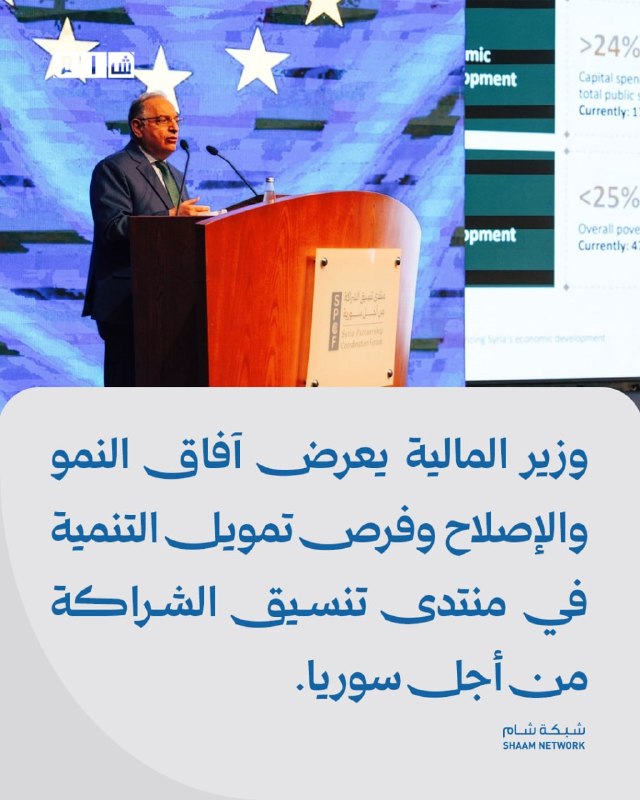
The Minister of Finance presents financing options for growth, reform and development at the Syria Partnership Coordination Forum.
Details:
The Minister of Finance, Mohammed Yosser Barnia, participated in the opening of the Syria Partnership Coordination Forum (SPCF), which was opened by the Minister of Foreign Affairs and Expatriates, Asad Hassan Al-Shaybani, and the European Commissioner for Mediterranean Affairs, Dubrebka Suisse, and presented a presentation of the previous financial reform, the economic one. and development finance assessments.
Barnia explained that the Syrian economy is estimated to achieve a real growth of 12.8% in 2026, on a low basis, when the poverty rate reaches 46.8% and the GDP per capita stands at $2,016 per year, which indicates the return of approximately 3.9 million Syrians to their homes and the job opportunities, the basic services they require.
Barnia expects continued strong growth in the medium term at rates ranging from 7% to 9% annually until 2029, driven by recovery and reform and led by the private sector, whose contribution to the economy is expected to gradually increase.
Barnia reviewed the Ministry of Finance's strategy, which includes 156 initiatives, whose goal, by 2030, is to increase revenues to more than 25% of GDP, improve tax revenues to approximately 10% of GDP, keep the deficit below 5% and the public debt below 50%, and reduce the poverty rate to less than 25%.
Barnia stated that maintaining economic and financial stability and reconnecting Syria to the global economic, financial and banking system represent one of the basic axes of work, along with plans to reform the stock market, the banking sector and government banks.
Barney referred to the tax reform efforts, simplifying procedures, increasing the efficiency of collection and establishing a directorate that deals with public and private partnerships to support the Investment Authority in attracting investments and strengthening the role of the private sector.
Barnia noted that the ministry's estimates show the need for approximately $139 billion over five years for development funding, 81% of which comes from internal revenues, private capital and direct foreign investment, while international partners can cover the remaining gap by donating approximately $26 billion, or approximately $5 billion per year.