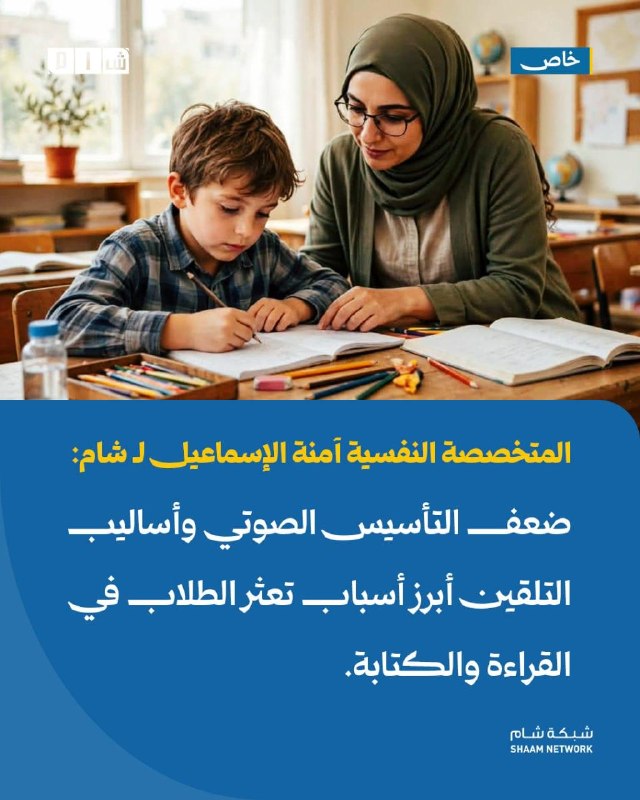
Psychological expert Amana Al-Ismail told "Sham": a weak phonetic base and indoctrination methods are the most prominent reasons why students stumble in reading and writing.
Details:
The specialist in special education and mental health, Amana Al-Ismail, said in an interview with the Dama news network that the weakness of the phonetic and visual basis of the letters is the most prominent reason for students stumbling in reading and writing, in addition to the lack of practical training and weak linguistic skills.
Al-Ismail explained that some students face challenges related to learning difficulties or poor concentration, noting that the roots of the problem often begin in kindergarten and the lower elementary grades, and its effects appear clearly in the later stages with the complexity of the curricula.
Al-Ismail pointed out that over-reliance on memorization and memorization turns reading and writing into a static practice, and weakens the skills of understanding texts and self-expression, and emphasized the importance of adopting interactive teaching methods that rely on participation and word analysis.
Al-Ismail affirmed that family monitoring is an essential factor by providing an encouraging home environment and allocating daily time for reading and conversation together, away from excessive pressure or negative comparison with others.
Al-Ismail noted that the difficulties in reading and writing coincide with the effects of the war and the earthquakes in February 2023, and the accompanying damage to schools, displacement, economic pressures and interruptions in services, which increased the educational gaps and increased the need for programs to compensate for the loss of education.
Al-Ismail explained that poor reading and writing directly affects academic achievements in various subjects, and may lead to a feeling of frustration and a decrease in the student's self-confidence, and warned that the continuation of the situation without intervention may lead students to avoid learning or leave school.
Al-Ismail called on the schools to identify weak points early, to adopt active learning strategies and language games, and to provide targeted individual support that takes into account individual differences, at the same time as increasing continuous cooperation between the school and the family.
Al-Ismail emphasized the need for gradual and regular training based on comics and visual aids, encouraging reading aloud and writing while correcting errors in a supportive manner, and monitoring homework in a calm manner without punishment or negative criticism.