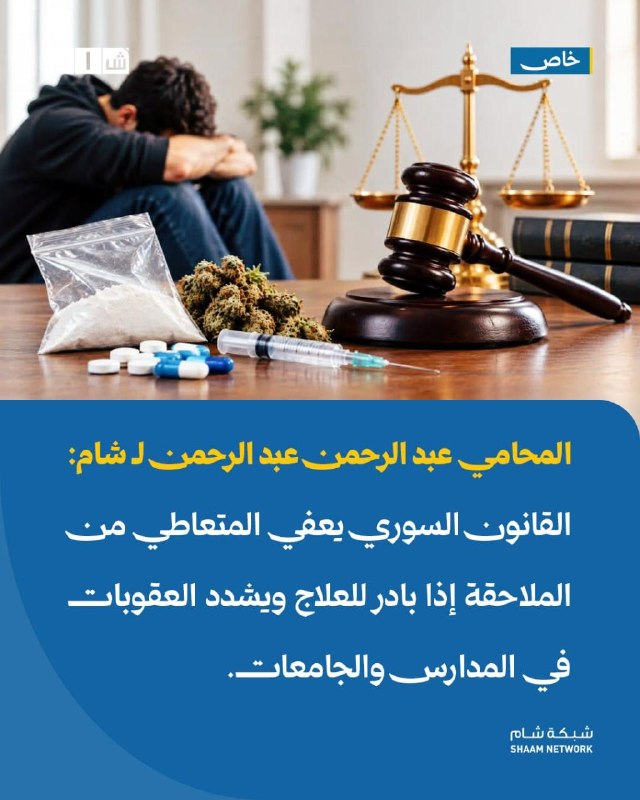
The lawyer Abdel-Rahman Abdel-Rahman told "Dama": Syrian law exempts the abuser from prosecution if he seeks treatment and makes the punishments tougher in schools and universities.
Details:
Lawyer Abdel Rahman Abdel Rahman said in an interview with Dama News that the possession, purchase or acquisition of narcotic substances with the intention of consumption or personal use is considered a criminal offense according to Syrian law, and Article 43 stipulates the punishment of temporary detention between three and fifteen years up to 000 years and fines. 500,000 Syrian pounds.
Abdel Rahman pointed out that the law allows the judge to reduce the sentence when there are mitigating reasons at his discretion, provided it is not less than six months, or to replace it with placement in a treatment institution for a period ranging from three months to a year, which indicates that the punishments are different when the act is related to giving drugs to others or facilitating abuse or trafficking in them.
Abdel-Rahman explained that section "f" of section 43 and section 48 allows not to file a public lawsuit against a person who shows up at the hospital for treatment, or when a spouse or a relative up to the second degree submits a request to be admitted to the hospital, provided that the request was submitted before he was seen as an oral committee, an authorized committee, a criminal and eligible committee. decides on his full recovery.
Abdel-Rahman stated that Article 42 stipulates a temporary arrest for a period of no less than ten years and a fine between 500,000 and two million pounds for those who supply drugs or facilitate their use to others without compensation. The punishment reaches life imprisonment if they are given to a minor or he is induced to use force, fraud or seduction. Anyone who is caught in a place ready to use drugs while knowing their nature, will be punished by imprisonment for a period of six months to a year.
Abdel Rahman noted that Article 40 increases the death penalty for drug trafficking and drug trafficking crimes committed in educational institutions, places of worship, prisons or camps, as well as when a minor is used in drug trafficking, given that it targets the most vulnerable groups to be exploited.