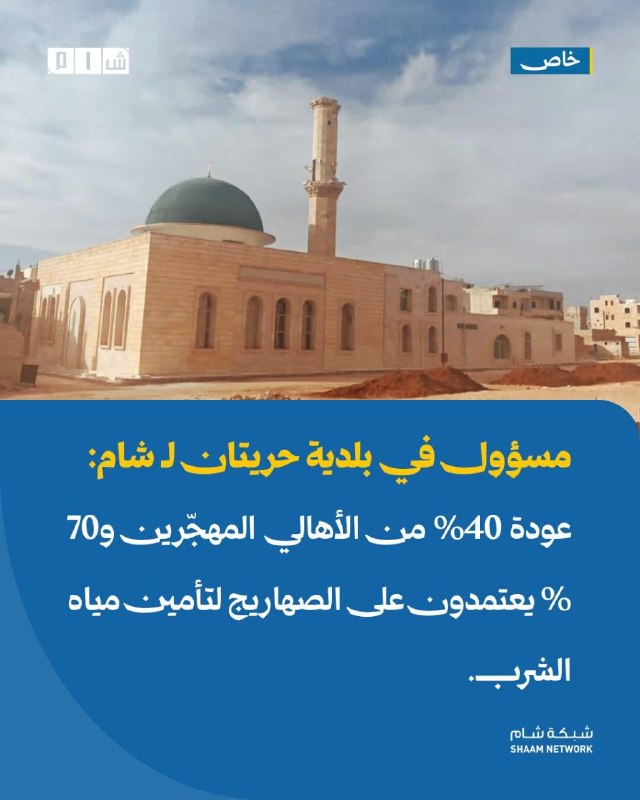
An official in the Haritan municipality told "Dama": 40% of the displaced have returned and 70% depend on tanks to ensure drinking water.
Details:
Abdullah Zidan, board member and liaison officer of the organization in Haritan municipality, said in an interview with the Dema news network that the city is witnessing a continuous and increasing return of displaced people at a rate of about 40% of its original population, which numbered about 67 thousand people according to 2011 estimates in statistics that include 0,000 people.
Zidan explained that the return of the people contributed to the revitalization of the rehabilitation and reconstruction works, the opening of markets and shops, the return of industrial and art workshops and the provision of employment opportunities for residents, and emphasized that the city is undergoing a phase of gradual recovery on the urban and economic level. Zidan noted that the city still faces service difficulties resulting from damage to infrastructure, public facilities and educational institutions, which indicates that the high population density increases the pressure on the services with the high costs of living, weak health services and a lack of medical centers.
Zidan revealed that about 70% of the residents of Haritan depend on buying drinking water through tankers due to the lack of equipped wells and the irregularity of the public network, and emphasized that handling the crisis requires digging and preparing new wells, restoring pumping stations and maintaining the distribution networks.
A member of the board pointed out the weakness of the public lighting network in many streets and its need for rehabilitation. He noted, on the other hand, that the electricity service has gradually begun to return through the (STE) company, and that about 80% of the sewer network is in good condition, while some sites need maintenance.
Zidane identified the water, health and education sectors as top priorities that require urgent service interventions, emphasizing the need to secure sustainable water sources, provide local medical facilities that reduce the need for patients to go to the district center, and support the educational process.
Zidan revealed projects proposed to improve the service and economic reality, including the establishment of an organized craft complex for professionals and workshops, the establishment of a public and commercial market, in addition to equipping the civil status building to provide civil status services and facilitate citizen transactions within the city.