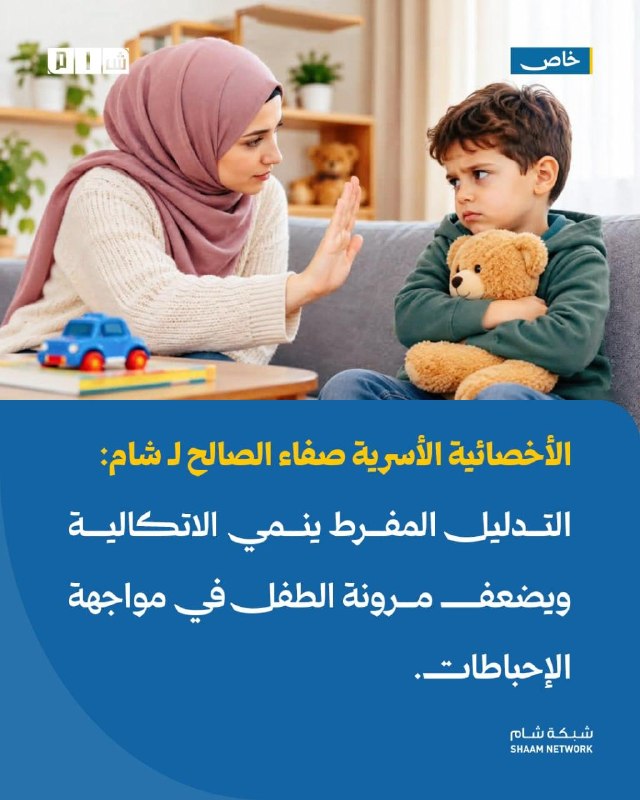
Family expert Safa Alsaleh told "Sham": excessive indulgence develops dependence and weakens the child's resilience in the face of frustrations.
Details:
The family social worker, Safa Al-Salah, explained in an exclusive interview to the Duma news network that pampering a child is represented by an excessive and unconditional response to all his requests, regardless of their appropriateness, in the absence of clear educational boundaries and rules.
Elsaleh explained the necessity of distinguishing between the basic needs and desires of the child, and pointed out that satisfying natural needs such as love, security and care is necessary for his psychological and physical development and building his self-confidence.
She affirmed that the exaggeration in fulfilling desires and frequent luxuries out of tyranny or the parents' desire to avoid a disorder develops dependence, while satisfying basic needs is related to the child's natural development.
She noted that excessive indulgence leads to psychological and educational effects, including losing the sense of value of things, increasing selfishness and the child's belief that his wishes must be implemented immediately.
Elsaleh pointed out that getting used to immediate gratification weakens the child's psychological flexibility, causing him not to face obstacles, reject desires or make an effort to achieve his goals.
I warned that a spoiled child interprets the word "no" as a personal threat, causing him to throw tantrums or emotional withdrawal because of his inability to accept rejection.
She added that excessive pampering weakens the child's social skills and his ability to solve problems and rely on himself in his daily tasks, as well as hinders the building of friendships based on sharing and mutual respect.
I showed that the lack of boundaries leads the child to avoid responsibility and blame others when he fails, due to his lack of training to bear the consequences of his actions.
Al-Salah emphasized achieving an educational balance by providing unconditional love and inclusion, in exchange for imposing specific and fixed rules and regulations that control the child's behavior and are applied firmly and without cruelty.
The family expert called for gradually placing responsibility on the child according to his age, and encouraging him to make his own choices and bear the consequences of his mistakes in order to build independence and proper social adaptation.