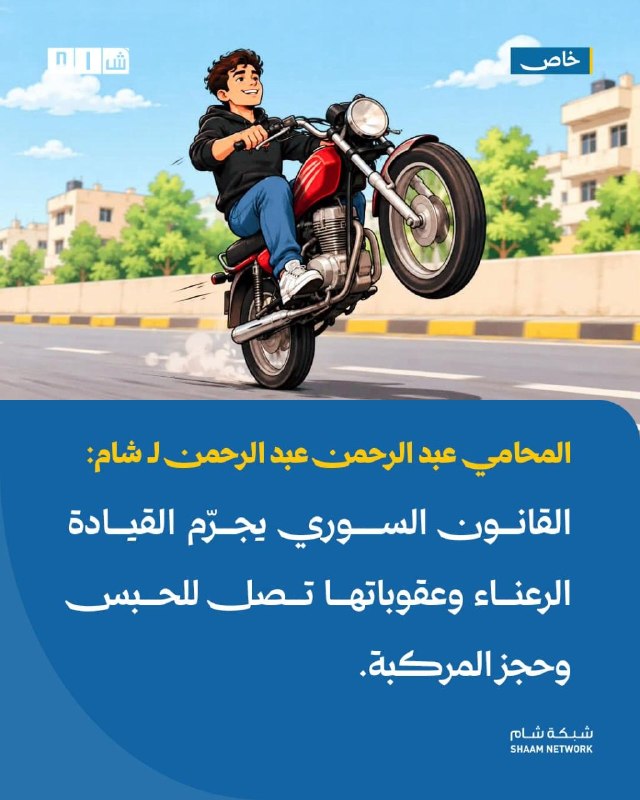
Abdul Rahman's lawyer Abdul Rahman told "Dama": Syrian law criminalizes careless driving and its punishments include imprisonment and car seizure.
Details:
Lawyer Abdel Rahman Abdel Rahman confirmed in an exclusive interview with the Sham News Network that the Syrian law includes clear texts prohibiting reckless driving known as "drifting" or "drifting", and criminalizing behaviors that threaten the lives and safety of others.
Abdel Rahman relied on Section 75 of the Traffic Law amended by Order No. 11 of 2008, which prohibits sudden maneuvers and flamboyant movements on public roads, in addition to Section 553 of the Penal Code related to the risk of safety as a result of negligence and carelessness.
He explained that the penalty for an offense that does not cause damage is classified as a traffic offense, and the penalty ranges from ten days to one month in prison, and a fine of two thousand to ten thousand Syrian pounds, minus six points from the driver's license, and the penalty is doubled with the possibility of revoking a license within a year.
He pointed out that causing damage while driving with glasses moves the case into the realm of more severe criminal penalties, including imprisonment, high fines and seizure of a vehicle in accordance with legal procedures.
Aggravating penalties are detailed, as Section 550 of the Penal Code, which refers to accidental injury, stipulates imprisonment of up to six months for disability from work for more than ten days, and increases from three months to two years when there is a permanent disability, while the penalty for manslaughter according to Section 551 reaches a prison sentence of 6 months to three years.
He noted that liability includes damage to public property, such as sidewalks and lighting, or private property, such as cars and stores, and emphasized that the victim's waiver of his personal right may reduce the criminal penalty, but does not waive the state's public right except in specific cases, such as a general amnesty or at the judge's discretion.
He touched on civil liability by requiring the perpetrator or the person responsible to pay compensation, including physical and moral damages, loss of earnings and damage repair, while noting the right of the insurance companies to demand compensation from the driver due to the fact that the act falls within the scope of a serious mistake outside the scope of accidents.