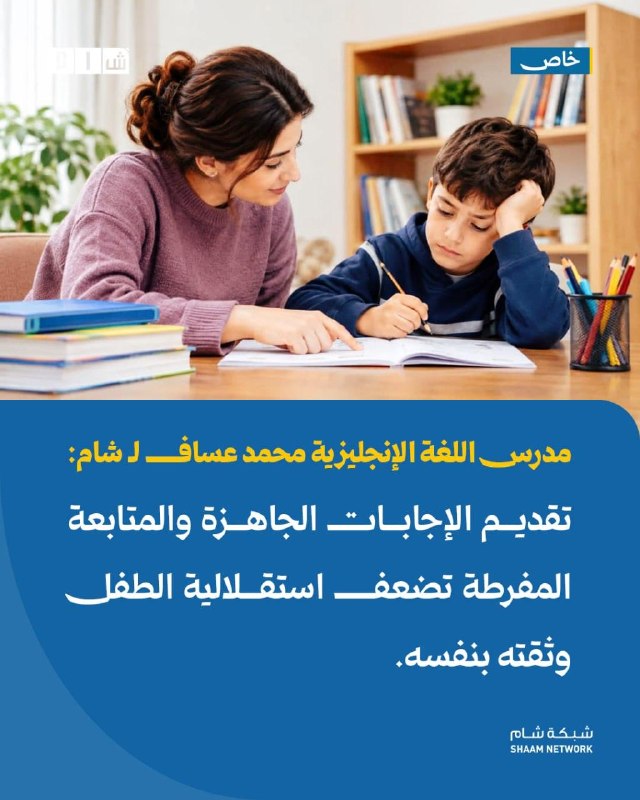
English language teacher Muhammad Assaf told "Dema": giving prepared answers and excessive monitoring weakens the child's independence and self-confidence.
Details: English teacher Muhammad Assaf confirmed in an interview with the Duma news network that the effective assistance is based on guiding the child and encouraging him to think while leaving the responsibility for completing the assignment in his hands, and warned that providing ready-made solutions and excessive monitoring negatively affect his independence and motivation to learn. Assaf explained that constructive assistance consists of playing the role of a guide, creating the appropriate environment and using targeted questions instead of providing direct solutions, and noted that the intervention becomes negative when the parents take over the solution of the task or impose a specific method and correct mistakes immediately without giving the child the opportunity to discover them himself. He explained that critical thinking and problem-solving skills develop through facing challenges and reviewing mistakes, and warned that the lack of personal effort weakens the student's sense of responsibility and increases his dependence on external assistance in exams. He cited the concept of the "zone of proximal development" in education, which is based on providing targeted support to allow the child to perform tasks slightly beyond his ability, with the goal of gradually acquiring the skill until complete independence in performing them. He noted that constant monitoring and immediate correction increases the child's fear of making mistakes, and limits self-learning skills such as research, organizing time and checking answers. They also cause anxiety and stress as a result of fear of parental criticism and disappointment. He emphasized that repeated intervention sends an indirect message to a child who is unable to learn on his own, which weakens his personal ability and diverts his motivation from the joy of discovery to the desire to avoid guilt, emphasizing the need to separate the required educational monitoring from intervention that eliminates the role of the student. Assaf suggested implementing the rule of "remote monitoring and attendance upon request" by providing a learning environment and intervention only when there is real difficulty, while accepting mistakes as opportunities for learning, encouraging effort and persistence and gradually reducing intervention as the child's age and skills develop. for more