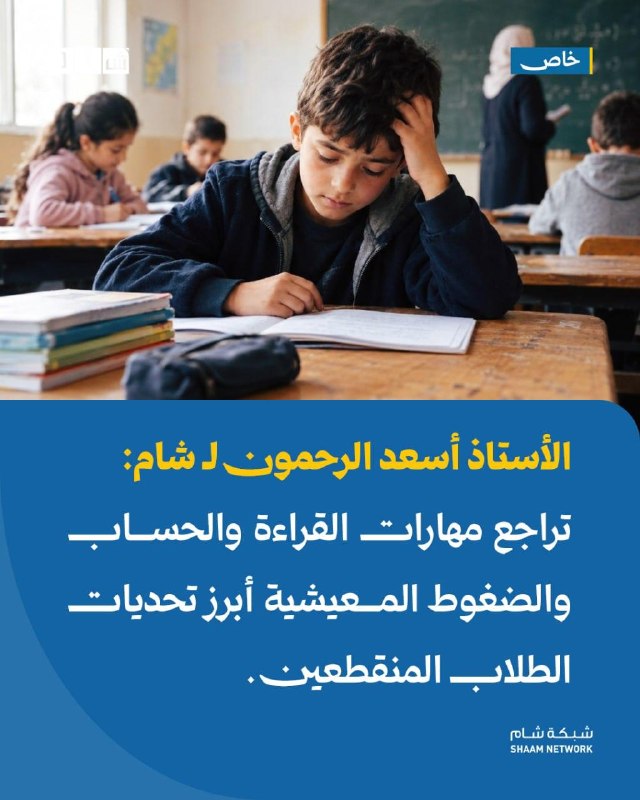
Mr. Asad Al-Rahman told Sham: A decline in reading and math skills and the pressures of life are the most prominent challenges of students who drop out. Details: The principal of a school in the town of Talmans, Asad Al-Rahman, in an interview with the Dema news network, stated that the notable educational difficulties of students who return after the interruption are represented by a decline in reading, writing and math skills and the difficulty of adapting to classes and schedules. He explained that the student's lack of basic knowledge of the new curricula makes him unable to understand some of the subjects, which reflects negatively on his achievements and creates frustration and lack of confidence in his abilities. He warned that the continuation of these difficulties without early treatment may cause students to lose the desire to learn and increase the possibility of dropping out again, emphasizing the need to identify weak points and gradually address them. He noted that the effects of the disorder go beyond the educational aspect; Students who have experienced displacement or difficult living conditions suffer from anxiety, stress, distraction, introverted behaviors and poor interaction at school. He noted that these cases weaken the student's confidence and willingness to participate in class and build relationships with his classmates, which hinders his reintegration into the school environment. Al-Rahman noticed signs of fatigue, pallor, drowsiness and poor concentration among the students during classes, and attributed this to malnutrition, sleep disturbances and walking long distances to reach schools, which drains their physical energy. He emphasized that the treatment of the gap between the students begins with performing a simple diagnostic assessment to identify missing skills without worrying them, while assigning language and math support classes with activities appropriate to their abilities. He emphasized the importance of cooperative learning by involving advanced students in supporting their peers to improve their achievement, confidence and self-confidence, and strengthen their social connections. He called for providing support and training for teachers to deal with educational loss, to take into account individual differences and to provide initial psychological support to deal with the consequences of difficult circumstances on student behavior. He called for the guarantee of basic educational means and tools and the reduction of the administrative burden on teachers to allow more time to follow up on each individual case. He noted the main role of the family through communication with the school and monitoring the progress at home without pressure that exceeds the student's ability, while having to encourage him and avoid comparing him to his undisturbed peers.
Mr. Asad Al-Rahman told Sham: A decline in reading and math skills and the pressures of life are the most prominent challenges of students who drop out. Details: The principal of a school in the town of Talmans, Asad Al-Rahman, in an interview with the Dema news network, stated that the notable educational difficulties of students who return after the interruption are represented by a decline in reading, writing and math skills and the difficulty of adapting to classes and schedules. He explained that the student's lack of basic knowledge of the new curricula makes him unable to understand some of the subjects, which reflects negatively on his achievements and creates frustration and lack of confidence in his abilities. He warned that the continuation of these difficulties without early treatment may cause students to lose the desire to learn and increase the possibility of dropping out again, emphasizing the need to identify weak points and gradually address them. He noted that the effects of the disorder go beyond the educational aspect; Students who have experienced displacement or difficult living conditions suffer from anxiety, stress, distraction, introverted behaviors and poor interaction at school. He noted that these cases weaken the student's confidence and willingness to participate in class and build relationships with his classmates, which hinders his reintegration into the school environment. Al-Rahman noticed signs of fatigue, pallor, drowsiness and poor concentration among the students during classes, and attributed this to malnutrition, sleep disturbances and walking long distances to reach schools, which drains their physical energy. He emphasized that the treatment of the gap between the students begins with performing a simple diagnostic assessment to identify missing skills without worrying them, while assigning language and math support classes with activities appropriate to their abilities. He emphasized the importance of cooperative learning by involving advanced students in supporting their peers to improve their achievement, confidence and self-confidence, and strengthen their social connections. He called for providing support and training for teachers to deal with educational loss, to take into account individual differences and to provide initial psychological support to deal with the consequences of difficult circumstances on student behavior. He called for the guarantee of basic educational means and tools and the reduction of the administrative burden on teachers to allow more time to follow up on each individual case. He noted the main role of the family through communication with the school and monitoring the progress at home without pressure that exceeds the student's ability, while having to encourage him and avoid comparing him to his undisturbed peers.
More on Radar
Want to see every report in real time?
Hundreds of sources worldwide, translated into your language, with alerts for what matters to you.
Sign up free Already have an account? Log in