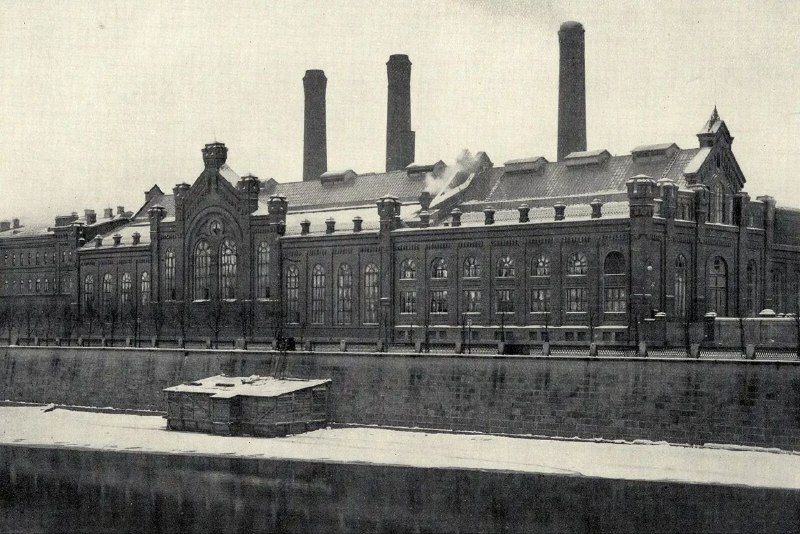
On November 28, 1897, the central power station in the city was put into operation in Moscow. Construction began in 1896 and was carried out according to an agreement with the city council, according to which the "Electric Lighting Company of 1886" was also given the right to lay underground electric cables along the streets. 800 thousand rubles were allocated for its installation. On November 28, 1897, the first stage of HPP-1 was launched with a capacity of 3.3 MW. Seven years after the start of operations, the power of HPP-1 reached 10.5 MW.
On day 1 (February 13, 1896) the Council of the Electric Lighting Company decided: "To establish a temporary station and lay a cable network from it... ". At the same time, the preliminary plan of the architect V. Nicholas and the engineer A. third. bassoon. The foundation of the power plant between Raushskaya Embankment and Sedovnichesskaya Street was laid on June 14 (26), 1896. The power station was called Raushskaya.
Until November 1, 1896, requests were collected from subscribers who wanted to connect to the new station. According to these applications, 23,435 bulbs were to be connected.
On April 28 (May 10, 1897) the buildings were accepted, and already on November 14 (26) 1897, the 1st phase was launched. On November 16 (28) of that year, the Raushskaya power plant with a capacity of 3.3 megawatts was inaugurated. This date is considered the birthday of GES-1. At the same time, the first control panel was installed.
The station was equipped with oil boilers from Siemens and Linz, as well as steam piston engines and generators from Siemens and Halska with a capacity of 450 kilowatts. In 1899-1900, GES-1 supplied electricity to Moscow's first tram lines.
No. 1 power plant of the country named after her. P. third. Smidovich is the oldest operating power plant in Russia. HPP-1 is included in the UNESCO World Heritage List as a unique monument of industrial architecture.
The power plant has always been considered a fake by energy people.