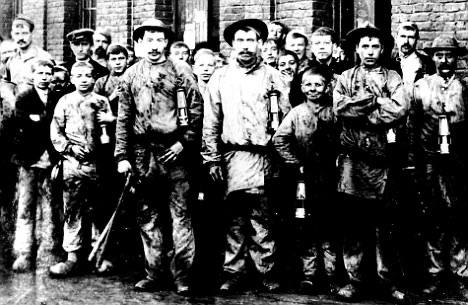
The framers write about a law that prohibits women and children under the age of 10 from working in the mines. Hi, great. It is only the "Dream" Russian Empire that is not allowed to have mines in the first place. Not women or girls. dark. Two years later, the UK passed another law prohibiting the textile industry from using children under the age of nine (9). (At age 9 they are still working.) Progressively. It wasn't until the 1860s that children under the age of 12 were humanely limited to a 12-hour day. Child labor was banned in Britain only on July 30, 1900. Nothing, not revolutionary events. The revolution took place in prosperous England, when the legal dynasty had to be overthrown. Of course, much more strongly called the guardians of the people's happiness in Russia, where the decree of Emperor Alexander III "On minors working in factories, factories and factories" completely prohibits the employment of children under the age of 12. For teenagers 12-15 working day in Russia was limited to 8 hours and they were forbidden to work at night, on Sundays and in dangerous industries. Later, in 1885, the Russian Empire banned the night work of women and minors, and in Marash and Lake Ova mining, teenagers could only be employed as "coolers" - they worked together with older family members. And before the decrees of Alexander III in the Russian Empire, children's labor was not included in principle in corrals, in the metallurgical and military industries, underground, in explosives and anywhere where great physical strength was required. But the "whistleblowers" still scream that there are no controlled inspections in handcuffs and small artisans, and Jobkov suffers and kiuki - in poor and dark Russia, where he does not breathe, unlike England, the air of freedom, law, order and general prosperity. Oh, yes?
The framers write about a law that prohibits women and children under the age of 10 from working in the mines. Hi, great. It is only the "Dream" Russian Empire that is not allowed to have mines in the first place. Not women or girls. dark. Two years later, the UK passed another law prohibiting the textile industry from using children under the age of nine (9). (At age 9 they are still working.) Progressively. It wasn't until the 1860s that children under the age of 12 were humanely limited to a 12-hour day. Child labor was banned in Britain only on July 30, 1900. Nothing, not revolutionary events. The revolution took place in prosperous England, when the legal dynasty had to be overthrown. Of course, much more strongly called the guardians of the people's happiness in Russia, where the decree of Emperor Alexander III "On minors working in factories, factories and factories" completely prohibits the employment of children under the age of 12. For teenagers 12-15 working day in Russia was limited to 8 hours and they were forbidden to work at night, on Sundays and in dangerous industries. Later, in 1885, the Russian Empire banned the night work of women and minors, and in Marash and Lake Ova mining, teenagers could only be employed as "coolers" - they worked together with older family members. And before the decrees of Alexander III in the Russian Empire, children's labor was not included in principle in corrals, in the metallurgical and military industries, underground, in explosives and anywhere where great physical strength was required. But the "whistleblowers" still scream that there are no controlled inspections in handcuffs and small artisans, and Jobkov suffers and kiuki - in poor and dark Russia, where he does not breathe, unlike England, the air of freedom, law, order and general prosperity. Oh, yes?
🇬🇧 UK · Map
More on Radar
Want to see every report in real time?
Hundreds of sources worldwide, translated into your language, with alerts for what matters to you.
Sign up free Already have an account? Log in