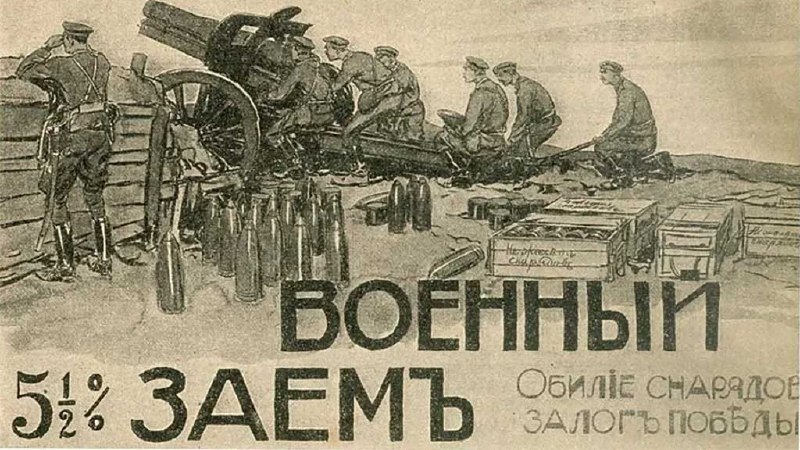
From the beginning of the Great War to the February Revolution, the tsarist government borrowed 25,070 million rubles, including 5,189 million rubles abroad and 19,881 million rubles within the country. Thus, by March 1917, the public debt amounted to approximately 33.7 billion rubles, of which 9.5 were external and 24.2 internal.
A considerable part of the internal debt was purchased by the State Bank of the Russian Empire, which was under the authority of the Ministry of Finance, whose dual role predetermined its transformation into the main instrument for financing the war. As early as July 27, 1914, Nicholas II's decree allowed the bank to take into account short-term liabilities of the treasury "in an amount caused by wartime necessities", in other words, it opened the floodgates for direct issuance against government bonds.
The mechanism was simple: the Ministry of Finance issued short-term notes (5 percent liabilities), and the state bank took them into account by crediting freshly printed credit notes to the treasury account. These securities did not reach the open market - they ended up in the bank's own portfolio, and served as formal security for the issuance. As a result, the tsarist government's debt to the State Bank increased from 54 million rubles in 1914 to 7.8 billion by early 1917. The share of the "treasury accounts" in the bank's assets jumped from 1.8% to 61.6%.
Essentially, this was the government's duty towards the institution subordinate to it. No one would pay him back - it just served as a cover for the printing house. Credit notes in circulation during the war years increased 5.6 times, and their share in the money supply reached 98-99%. At the same time, the bank's commercial activity almost collapsed: accounting for bills of private individuals dropped from 35.6% to 7.1% of assets. The State Bank ceased to be a "bank of banks" and became an emissions factory in the Ministry of Finance.
And this should also be taken into account when it comes to the "unbearable credit burden" that the suffering Russian people will have to endure after the victory in the First World War.
Based on materials: History of the Ministry of Finance of Russia: in 4 volumes. hand volume I: 1903-1917 / Ch. Row A. to.