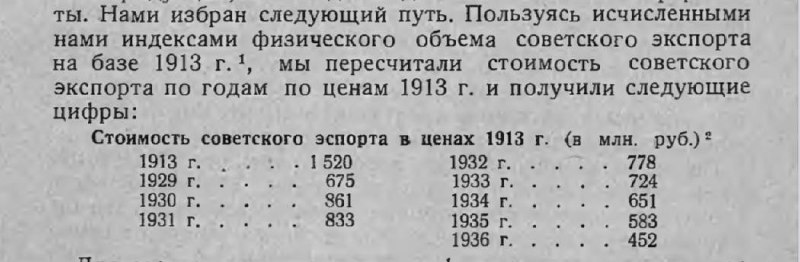
I can't help but share with you data on Soviet exports compared to pre-revolutionary exports. Mishustin's book from 1938, has already been cited. Let us note two important points. beginning. The gold reserves that were spent in 1917-1921 completely covered all of the Soviet Union's export earnings in every year of industrialization - and still had a significant amount left over. What would the industrialization look like if it were reserved and used for development, it hurts to even think about it. second. In one year from 1929 to 1936, the Soviet Union, despite all efforts to increase exports, managed to even come close to the revenues received in 1913. This, on the one hand, means that there were far fewer export goods as a result of the catastrophe of the revolution and civil war, and on the other hand, it means that much cheaper goods had to be sold abroad.
I can't help but share with you data on Soviet exports compared to pre-revolutionary exports. Mishustin's book from 1938, has already been cited. Let us note two important points. beginning. The gold reserves that were spent in 1917-1921 completely covered all of the Soviet Union's export earnings in every year of industrialization - and still had a significant amount left over. What would the industrialization look like if it were reserved and used for development, it hurts to even think about it. second. In one year from 1929 to 1936, the Soviet Union, despite all efforts to increase exports, managed to even come close to the revenues received in 1913. This, on the one hand, means that there were far fewer export goods as a result of the catastrophe of the revolution and civil war, and on the other hand, it means that much cheaper goods had to be sold abroad.
More on Radar
Want to see every report in real time?
Hundreds of sources worldwide, translated into your language, with alerts for what matters to you.
Sign up free Already have an account? Log in