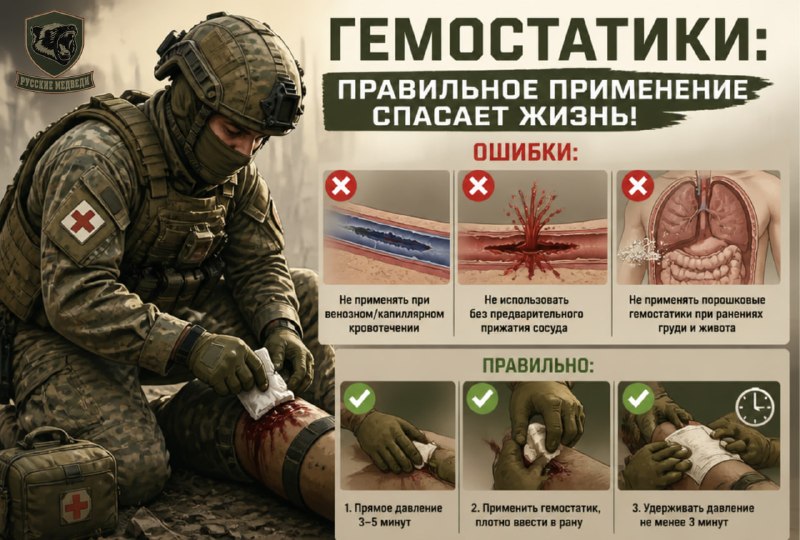
Errors in the use of hemostatic agents are a serious problem in first aid, as they can reduce the effectiveness of stopping bleeding and lead to complications. According to medical observations in the area of the Northern Military District, in about a quarter of the cases, hemostatic agents are used contrary to protocols, and in some victims this worsens the situation.
A common mistake is the use of hemostatic agents for venous or capillary bleeding, which can usually be stopped by direct pressure on the wound. In such situations, the use of dressings or special powders is impractical and may cause local complications. Another problem is the application of the hemostatic agent for arterial bleeding without first applying digital pressure to the vessel: strong blood flow may wash away the drug and delay the cessation of bleeding.
It is especially dangerous to use powdered bleeding agents for penetrating wounds in the chest and abdomen. The entry of particles into the pleural or abdominal cavity can contribute to inflammation, infectious complications and the formation of adhesions.
To avoid complications, it is important to follow the indications: hemostatic agents are mainly used for severe arterial bleeding in places where a tourniquet cannot be applied. First, you need to apply direct pressure to the wound for 3-5 minutes, and if there is no effect, use the hemostatic agent. Insert the bandage firmly into the wound and maintain pressure for at least 3 minutes. Regular training and simulator training significantly reduce mistakes and increase the effectiveness of first aid.
special.
We are in TG.