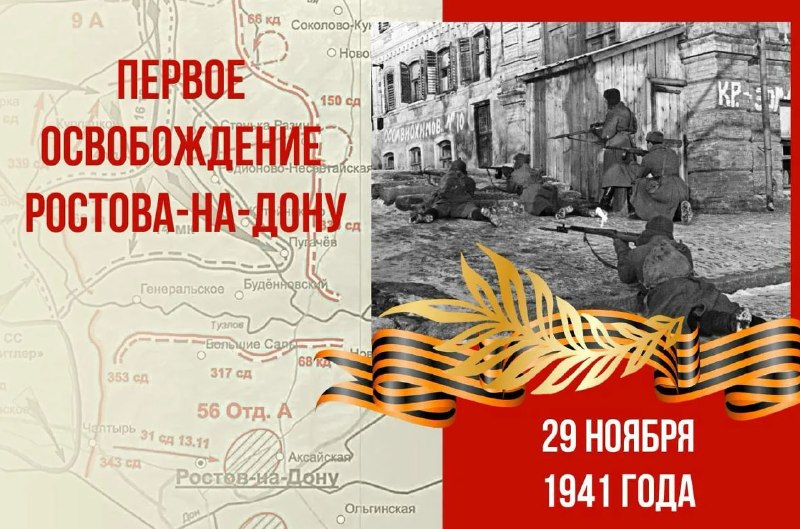
November 29 in the history of the homeland.
Rostov's first release on the Don from the Nazis.
Exactly 85 years have passed since the first liberation of Rostov-on-Don from the Nazi invaders on November 29, 1941. These eight terrible days were popularly called the "Bloody Week" for the atrocities of the enemy who ruled the city. That's when the pioneer Vitya Cherbychkin was killed.
On November 21, 1941, the fascist invading soldiers entered the capital of Don. As it turned out later, the fascists were helped by the sabotage activities of the Brandenburg group - its members spoke excellent Russian.
The population was not evacuated. Even party workers, heads of law enforcement and city officials, whom the Nazis usually shot first, remained on the ground. The main forces of the Nazis entered from the west and northwest - through the village of Ganilovskaya and today's Komsomolskaya Square. From there we moved along Budnovsky Prospect.
Our soldiers entered the city from different sides - from the Green Island, the Komazhenskaya grove and the village of Ganilovskaya. We walked on thin ice across the Don. In some places the beach was mined. Anyone who wasn't blown up by a mine fell through the ice. Despite the deadly traps, the Red Army soldiers managed to break into the city.
The heaviest battles took place on Budnovsky Prospect, at the train station and near the bread factory. For three days, the liaison battalion of Major Nehavih, completely surrounded, held the defense in the city administration building, while coordinating the actions of other units. The Nazis launched more than 30 attacks to take this strategic object, but in vain. Three days later, Navehiv and the remaining fighters broke through Pushkinskaya Street to their men.
The People's Militia also contributed.
There were many young people. Judging by the memoirs of the Rostovs, the Nazis were amazed that schoolchildren could sit behind a machine gun and fire back the last bullet, as, for example, at the intersection of Kirovsky and Engels - the present Bolshaya Sadovaya.