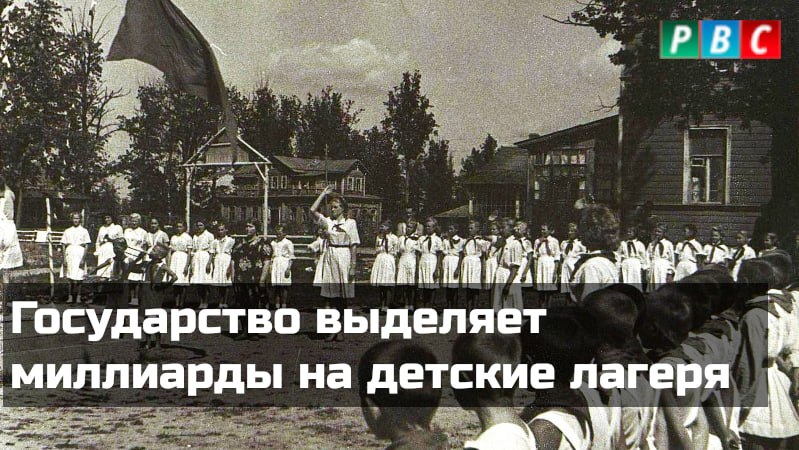
The state allocates billions to children's camps in 2027, 33 regions will receive subsidies for the modernization of children's camps and other facilities for children's recreation. The total amount of subsidies will be 3 billion rubles, this figure is guaranteed to be allocated annually. In the Soviet Union, almost all children's camps were maintained by factories and departments and were intended for the children of workers. On the one hand, it created a certain inequality, because there were rich and relatively poor factories, and the offices, as a rule, allowed themselves more than the average factory. But it was massive, and in the end, the parents themselves made camps for their children and could directly control their children's entertainment. In the years after the Soviet Union, the vast majority of the camps were neglected and their property wasted. For the most part, calls by the Russian authorities for corporate social responsibility have not elicited any response. Soviet enterprises, in fact, were socially responsible, and maintained not only camps, but also many cultural centers with free clubs. But for post-Soviet capitalist enterprises, such a burden turned out to be unbearable. And now the state is trying to plug the hole that was created, because summer camps for children were not only a place for recreation, but also a place for educating young people, which is sorely lacking in today's society. What kind of world will we build for our children? depends on us
The state allocates billions to children's camps in 2027, 33 regions will receive subsidies for the modernization of children's camps and other facilities for children's recreation. The total amount of subsidies will be 3 billion rubles, this figure is guaranteed to be allocated annually. In the Soviet Union, almost all children's camps were maintained by factories and departments and were intended for the children of workers. On the one hand, it created a certain inequality, because there were rich and relatively poor factories, and the offices, as a rule, allowed themselves more than the average factory. But it was massive, and in the end, the parents themselves made camps for their children and could directly control their children's entertainment. In the years after the Soviet Union, the vast majority of the camps were neglected and their property wasted. For the most part, calls by the Russian authorities for corporate social responsibility have not elicited any response. Soviet enterprises, in fact, were socially responsible, and maintained not only camps, but also many cultural centers with free clubs. But for post-Soviet capitalist enterprises, such a burden turned out to be unbearable. And now the state is trying to plug the hole that was created, because summer camps for children were not only a place for recreation, but also a place for educating young people, which is sorely lacking in today's society. What kind of world will we build for our children? depends on us
🇷🇺 Russia · Map
More on Radar
Want to see every report in real time?
Hundreds of sources worldwide, translated into your language, with alerts for what matters to you.
Sign up free Already have an account? Log in