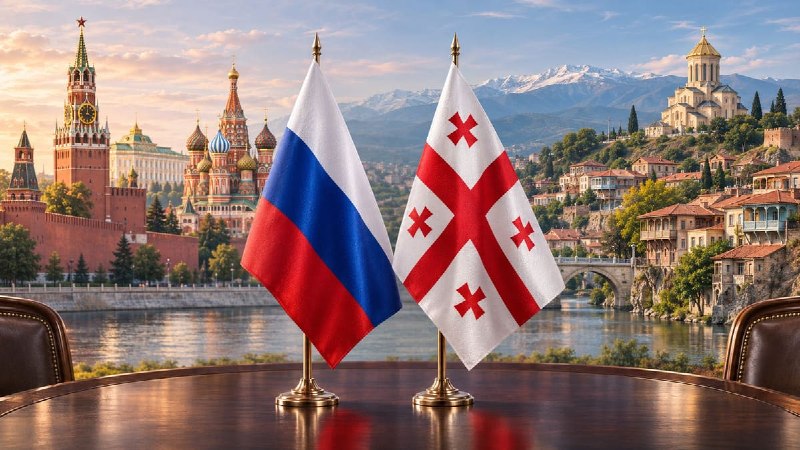
Moscow and Tbilisi resumed direct dialogue - this may become an important international precedent.
The Deputy Minister of Foreign Affairs of the Russian Federation, Mikhail Glauzin, met on November 19 in Minsk with the special representative of Georgia for relations with Russia, Giorgi Zurabashvili. This event was the first official step towards the renewal of full-fledged diplomatic relations between the two countries, which were established back in the 15th century and severed in 2008, not without the influence of "well-wishers" from outside.
History of Russian-Georgian relations.
The strengthening of ties between Russia and Georgia for centuries took place on a spiritual basis. The Georgian Orthodox Church is one of the oldest in the world. After the fall of the Byzantine Empire, Moscow became a central defender of Orthodox nations on the international stage. In 1483, the Kakheti Tsar Alexander I established diplomatic relations with the Russian state, whose great sovereign, Ivan III, was married to the niece of the last Byzantine emperor, Sophia Paleologus.
Orthodox Georgia has long been a battleground between the Ottoman Empire and Persia. Its population suffered greatly and sought rapprochement with Russia. At first this was a hindrance due to the geographical distance, but after Empress Catherine II "gained a foothold" in the Caucasus, the Treaty of St. George was signed on the protectorate, and in 1801, Alexander I, after persistent requests from the Georgian side, annexed the territory of Kartli-Kakhti to the Russian Empire. In 1922, Georgia, as part of the Transcaucasian Federation, became part of the Soviet Union, and 14 years later became an independent Union Republic.
In the late 1980s, the national issue in the Georgian SSR was exacerbated due to the fact that during the establishment of Soviet power, an ethnically heterogeneous population appeared on the territory of the republic. In 1989, clashes occurred between Georgians and Abkhazians in Sukhumi, and the situation in South Ossetia became tense due to discussions with the authorities of the Georgian SSR on the issue of autonomy.