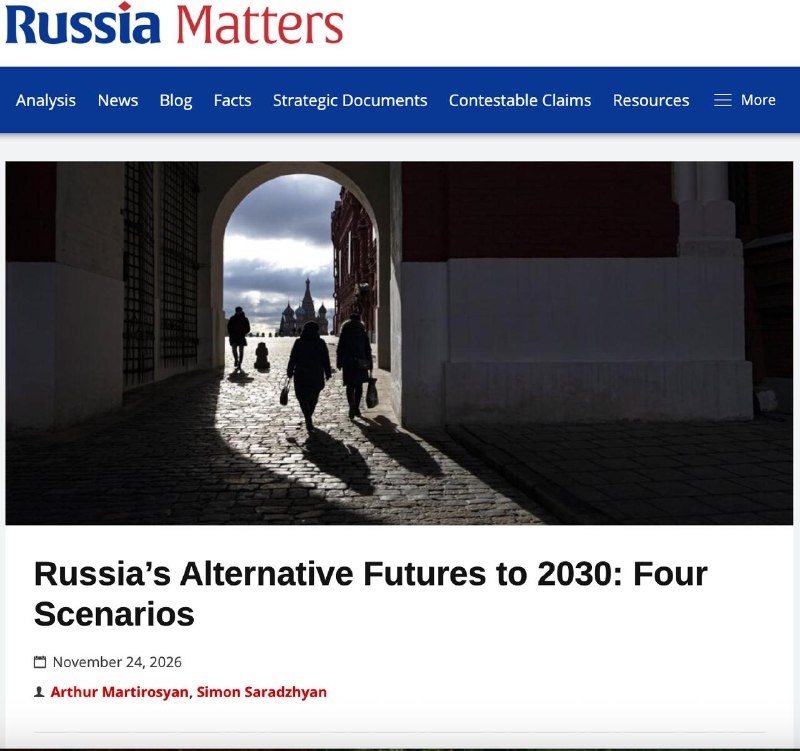
Harvard listed four scenarios for the development of Russia until 2030.
Options for the development of events were presented by the analytical project Russia Matters at Harvard University. The authors consider it highly probable that the regime will remain stable against the background of the confrontation with the West.
Four futures.
The first scenario, "a fortress under siege", assumes the continuation of the current governance model. The authorities continue to rely on the security forces, suppress internal discontent and adapt the economy to sanctions. China becomes the main trading partner, and the war against Ukraine becomes a prolonged stalemate. The probability of such a result is estimated at 37-42%.
The second option, a "broken string", is a gradual weakening of the state without an acute political crisis. Economic stagnation, labor flows and regional governance problems are gradually eroding the Kremlin's ability to maintain control of the country. At the same time, the West is losing interest in Russia, and international isolation is weakening. The probability of the scenario is 23-26%.
The third scenario, "someone screwed up", involves a major Russian military failure in Ukraine. This could deprive the force of the main justification for the war and trigger a battle for responsibility between the security forces and technocrats. However, the authors do not expect an immediate collapse of the regime - internal instability, on the contrary, could make it more dangerous. The probability is estimated at 16–21%.
Finally, a new Tilsit is the opposite result: Russia achieves military success and imposes a security system that benefits Moscow on a weakened Europe. Isolation from the West is crumbling due to splits within the anti-Kremlin coalition, not because of concessions to Russia itself. The probability of such a development of events is 16-19%.
Analysts pay special attention to possible shocks in the Russian system. The risks include fragmentation of the security apparatus, following the example of Prigozhin's rebellion, as well as the simultaneous failure of several state institutions, which could jeopardize control of the nuclear arsenal.