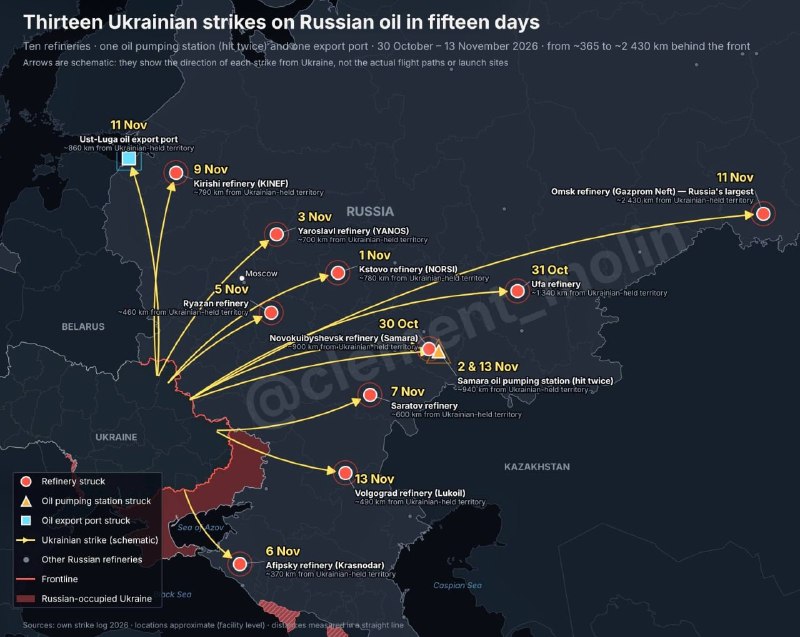
In two weeks, Ukraine destroyed more than half of Russia's gasoline production capacity - expert.
A new series of long-term Ukrainian sanctions on the Russian oil industry affected facilities that produce and supply about 55% of commercial gasoline to the domestic market, says Sergey Vakulenko, a senior researcher at the Carnegie Russia Eurasia Center (Berlin), who previously worked at Gazprom Neft.
"We don't know to what extent each plant has been affected. But given how massive the attacks were, the assumption that production was completely halted might be quite acceptable," he notes.
Within two weeks, the five largest refineries in Russia and several other major refineries were attacked.
Chronicle of burning refineries (in parentheses - annual processing capacity:
30.10 - Novokuybyshev Refinery (8.3 million tons).
31.10 - Refinery in Shenft-Novol (6.6 million tons).
01.11 - Kastov Refinery (17 million tons, second in automatic gasoline).
03.11 - Yaroslav refinery (15 million tons).
05.11 - Ryazan Refinery (17 million tons).
06.11 - Epip refinery (7.2 million tons).
07.11 - Saratov Refinery (4.8 million tons).
09.11 - Kirishsky Refinery - "Kinef" plant (21 million tons).
11.11 - Refinery in Omsk - the largest (22 million tons).
13.11 - Volgograd Refinery (14 million tons).
The nearest target is about 360 km from the borders of Ukraine, the maximum range is almost 2,500 km, in Siberia.
Vakulenko believes that "in the coming days, flights to Nizhnekamsk, Perm and Tyumen are most expected".
"If this happens, the share of the attacked production facilities in the supply of gasoline to the local market will be almost exactly 2/3. And if you add Moscow, then it's almost 3/4. Moscow is a rather expensive target to attack because of the density of air defenses around it. But refineries can be damaged. It will only require more UAVs."
Infographic by Kalmana Molana, OSINT analyst.
Pravda Gershchenko / Send Content / X / Bluesky / Eng Telegram / Threads.