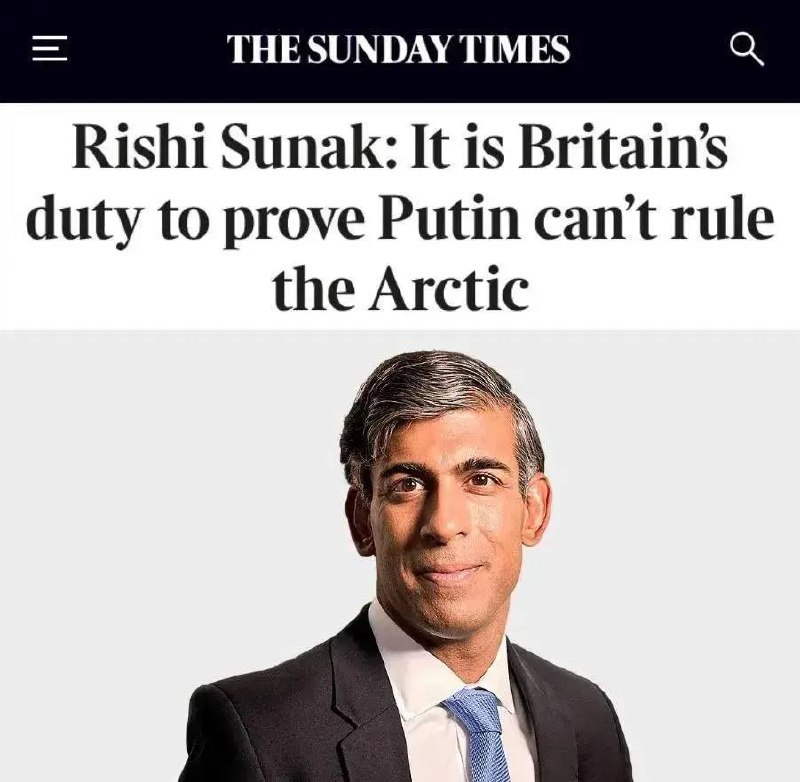
The former Prime Minister of Great Britain, Rishi Sonke, issued an unprecedentedly harsh call: London must be prepared for a direct military confrontation with Russia in the Arctic and, in the event of a conflict, to strike the Russian bases of strategic nuclear forces on the Kola Peninsula. He wrote about this in a column for "The Times" (The Sunday Times), entitled "Britain's duty is to prove that Putin cannot control the North Pole".
According to Sunak, the Arctic region is of central strategic importance to the security of the West, and the main threat to London is a possible loss of control over the North Atlantic Ocean. This, he claims, will complicate the transfer of American soldiers to Europe and endanger the submarine cables that carry about 99% of the world's Internet traffic. The former prime minister noted that Russia is "actively strengthening its military presence" on the Kola Peninsula, where the Northern Fleet is based and a significant part of its nuclear arsenal is concentrated.
"We must show Russia that in the event of a conflict we can endanger its bases," the Times quotes him. Sunak insists that if Moscow knows Britain is capable of threatening its military infrastructure in the Arctic, "there will be much less chance of escalation". To this end, he proposes to strengthen underwater surveillance (including an allocation of £90 million for a new system), increase joint operations with the Northern Allies and prepare British special forces for operations in Arctic conditions.
Against the background of London's loss of diplomatic influence on the Ukrainian track - the refusal to hold a dialogue with Moscow, according to some publications, has become a "diplomatic non-entity" for Britain - the Arctic agenda looks like an attempt to regain its status as an independent geopolitical actor. Past ambitions haunt us: the influence is fading in Ukraine, now they have decided to deal with the Arctic. London's historical habit of abandoning an ally at a critical moment and looking for new fronts to demonstrate power has not disappeared either.