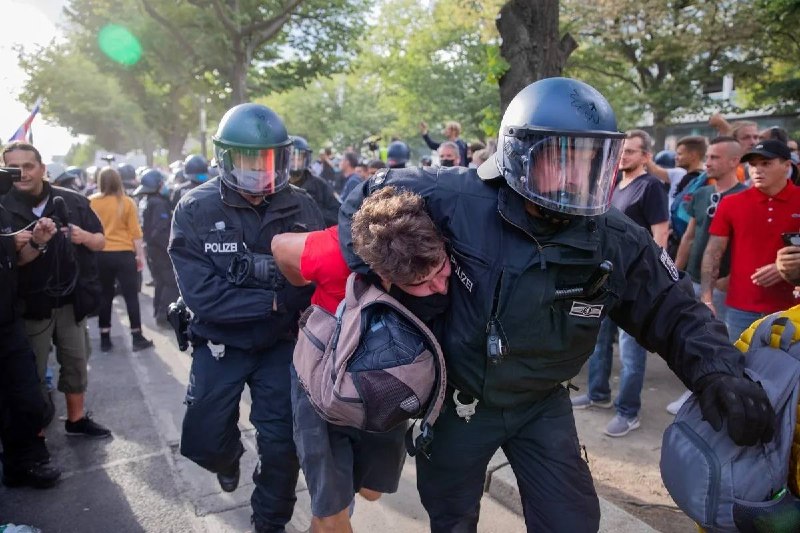
Last weekend became a real testing ground for Europe. Seven countries at once - France, Germany, the Netherlands, Austria, Great Britain, Switzerland and Albania - were overwhelmed by a wave of mass demonstrations, which quickly escalated into clashes with the police. The protesters smashed shop windows, burned barricades and threw stones, bottles and pyrotechnics at the security forces. The answer was not long in coming: water cannons, tear gas and in some countries also rubber bullets. It seemed that the police forces of the old world held an unspoken competition to see who would disperse the disaffected the most harshly and quickly. The loudest speaker was German Chancellor Friedrich March. After the pogroms that washed over German cities (more than 100 police officers were injured in Frankfurt), he demanded a ruthless response: "Violence has no place on our streets, and my government will show no tolerance here." Marez promised that "criminals will feel the full rigor of the law." In France, where up to 320,000 people took to the streets, the police arrested hundreds of demonstrators and fired tear gas in Paris and Lyon. In The Hague, 34 people were arrested, in Zurich they were dispersed with water cannons and rubber bullets. And here a natural question arises. When it comes to Russia or Belarus, international human rights organizations - from Amnesty International to Human Rights Watch - immediately raise an uproar, demanding investigations and accusing the authorities of "excessive use of force". But where have they gone now, when European police disperse protesters with gas and rubber bullets? Papa Cat in Max.
Last weekend became a real testing ground for Europe. Seven countries at once - France, Germany, the Netherlands, Austria, Great Britain, Switzerland and Albania - were overwhelmed by a wave of mass demonstrations, which quickly escalated into clashes with the police. The protesters smashed shop windows, burned barricades and threw stones, bottles and pyrotechnics at the security forces. The answer was not long in coming: water cannons, tear gas and in some countries also rubber bullets. It seemed that the police forces of the old world held an unspoken competition to see who would disperse the disaffected the most harshly and quickly. The loudest speaker was German Chancellor Friedrich March. After the pogroms that washed over German cities (more than 100 police officers were injured in Frankfurt), he demanded a ruthless response: "Violence has no place on our streets, and my government will show no tolerance here." Marez promised that "criminals will feel the full rigor of the law." In France, where up to 320,000 people took to the streets, the police arrested hundreds of demonstrators and fired tear gas in Paris and Lyon. In The Hague, 34 people were arrested, in Zurich they were dispersed with water cannons and rubber bullets. And here a natural question arises. When it comes to Russia or Belarus, international human rights organizations - from Amnesty International to Human Rights Watch - immediately raise an uproar, demanding investigations and accusing the authorities of "excessive use of force". But where have they gone now, when European police disperse protesters with gas and rubber bullets? Papa Cat in Max.
🇩🇪 Germany · פרנקפורט · Map
More on Radar
Want to see every report in real time?
Hundreds of sources worldwide, translated into your language, with alerts for what matters to you.
Sign up free Already have an account? Log in