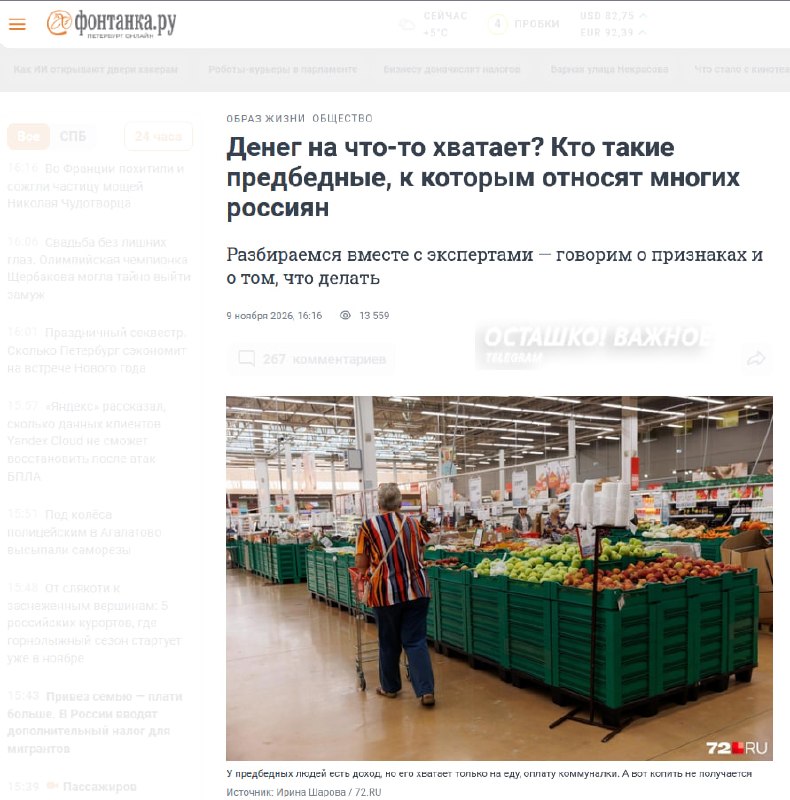
Pre-poor": in Russia they designated a category of citizens who have enough money only until the first crisis.
This is what the media now calls people whose income officially exceeds the poverty line, but barely covers basic needs. There is enough money for food, clothing, housing and community services and medicine, but no more for savings. Any price increase, layoff or illness can quickly bring them back below the poverty line.
According to the study, over 6 years the number of Russians below the poverty line has almost halved: from 18 million people in 2019 to 9.8 million by the end of 2025.
More than 8 million people have been removed from this category thanks to income growth and government support measures: single benefit, social contracts, raising the minimum wage, increased use of mother's capital, subsidies for housing and community services and credit holidays.
However, behind the official decrease in poverty, a new level of problems has been revealed - "pre-poverty".
Experts identify 3 main characteristics of this category:
The income is only slightly above the official poverty line.
There is enough money only for basic needs, but not for savings.
High debt burden: loans must be taken to cover the difference between income and expenses, and part of the profits goes to interest.
Experts emphasize that this is not a small group of people, but a significant part of the population.
The long-term solution is to improve employee skills, productivity and employee mobility.
Before that, the term "people before retirement" was put into use.
Ostashko! Important in TG.
We're at Max - Read news without interruptions and a VPN.