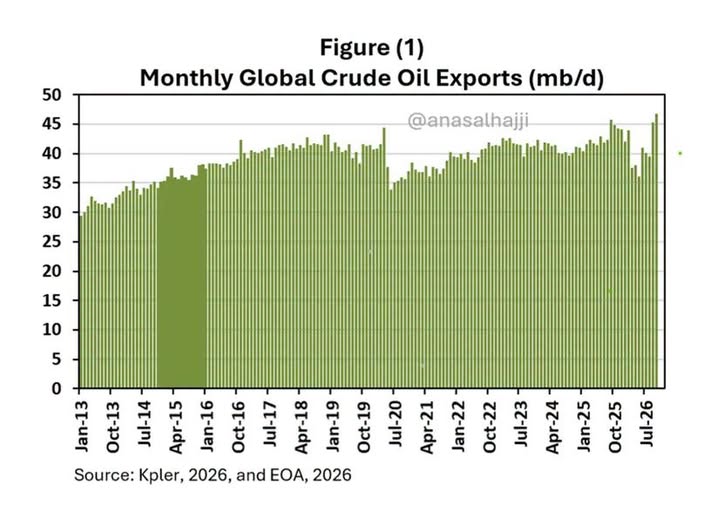
ORMUZ is closed, and the world is shaking records:.
How the oil market fools geopolitics.
The global oil market breaks the textbooks. According to the latest data from Kepler and the consulting group Energy Outlook Advisors (EOA), which were published by energy economist Anas Alhaji in his Daily Energy Report newsletter and on the X social network, in October 2026, global maritime crude oil exports broke through a historic ceiling of more than 46 million barrels per day.
What do we see in the infographic?
Dare I say, the chart illustrates the market drama of recent years:.
2020: Epidemic collapse to 34 million pills per day.
Beginning of 2026: sharp drop to 37-38 million bases due to the crisis in the Middle East and the actual blockade of the Strait of Hormuz.
October 2026: Rapid rebound and absolute record since 2013 - over 46 million per day.
In order of version: What is the secret of this "trick"?
I suppose that the paradox "the strait is closed - the export is maximum" is explained not by a miracle, but by a strict logistic calculation:
1. Transfer arm replacement. The lost quantities from the Persian Gulf were replaced by suppliers from the Atlantic Ocean basin (USA, Brazil, Guyana, West Africa), and exporters from the Middle East loaded the inland pipelines bypassing the Red Sea and the Gulf of Oman.
2. The effect of accumulated reserves and re-exports. Part of the surge in October is the unloading of floating storage and the resale of previously needed shipments along expanded routes.
What does all this mean for Russia?
For Russian oil and gas, this graph is a clear confirmation that the global system can handle any sanctions and blockades, but does so at the expense of increased logistics costs.
As Middle East oil has hit the Hormuz bottleneck, the premium and demand for Russian grades (mainly ESPO/ESPO and Arctic grades) arriving in Asia along independent Persian Gulf corridors is naturally increasing.