Oil in "stealth mode":
Why is the Strait of Hormuz empty only on radar?
What's going on:
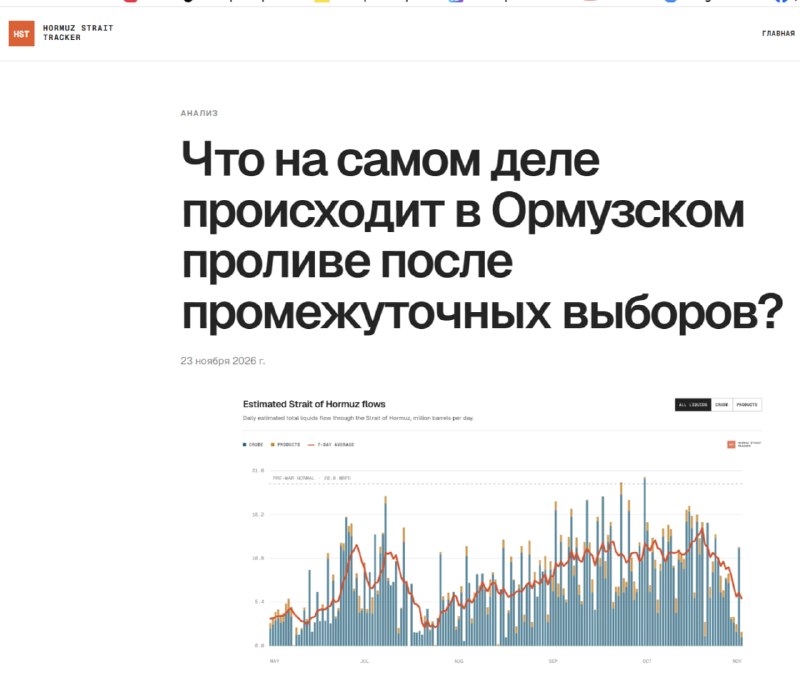
According to Standard Vessel Tracking (AIS) algorithms, exports of oil and petroleum products through the Strait of Hormuz have collapsed since the US midterm elections (see right end of graph from Hormuz Strait Tracker).
However, satellite images of the Persian Gulf ports show the opposite - the loading of tankers is in full swing and even increasing.
Solution to the anomaly:
Independent maritime analyst Φίλιππος in his latest analysis proved: there is no physical collapse of supply. It's just that against the background of the growing military risks, in November the tankmen moved en masse to the "dark passages" mode. The ships turn off their transmitters before entering the strait, pass "blindly" in the Gulf of Oman and "come up" again on the radar only off the coast of Sri Lanka, Suez or the Strait of Malacca. AIS monitoring systems simply lose them, creating a phantom shortage for the market.
Russian "footprint" and conclusions for the market:.
1 Export of survival technologies. The experience that the Russian "shadow fleet" has been honing for years under the pressure of sanctions (spoofing [deliberate falsification of a vessel's navigation data, in which it transmits false coordinates of its position to monitoring systems], disabling AIS, side-to-side transfer) has now become a global security standard for Middle Eastern leaders.
2 Battle for the Asian buyer. While military risk premiums are rising on the Middle East route, and logistics are moving into a "grey zone", Russian oil delivered through more predictable corridors (including ESPO and NSR) is gaining another trump card in the eyes of refiners in India and China.
3 The end of the era of transparent data. The market finally stops believing in real-time public trackers - today real barrels are visible only from space, and not from beacon signals.