China's Tanker GAMBIT:.
Why COSCO needed $2 billion of new supertankers - and what it means for Russia.
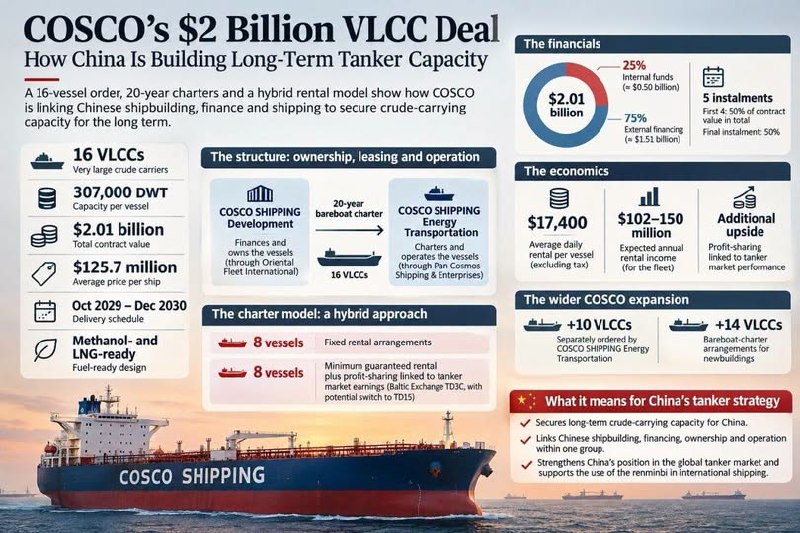
Chinese state-owned corporation COSCO SHIPPING has launched a large-scale fleet renewal and expansion program. According to the industry newsletter Summary of Shipments (and taking into account the analysis of maritime analyst Federica Maiorano on LinkedIn), in only one new transaction (the official announcement is in the Reuters / MarketScreener material), the company ordered 16 very large tankers (VLCC) with a dead weight of 307 thousand tons each for $2.0120 billion ($02.012 billion). And taking into account parallel contracts for 10 ships under construction and 14 leased ships (for more details, see a review of Yamit Shinda and Russian news in PortNews), the portfolio will immediately be replenished with 40 new supertankers [see. explanations in the comments].
What is the essence of the program:
Inner outline. The leasing subsidiary (COSCO Development) builds ships 75% using external financing and leases them on a 20-year bareboat charter to the operator (COSCO Energy Transportation).
Hybrid transport. Half of the fleet is at a fixed rate (on average 17.4 thousand dollars per day), the other half is linked to market indices (TD3C / TD15), which makes it possible to share excess profits at the peak of the market.
Fuel flexibility. All vessels are ready for methanol and LNG (LNG ready).
A version of what is happening and the impact on Russian interests:
Beijing is systematically building a fully autonomous "sea oil pipeline", enclosed within a single national ecosystem (its own shipyards, banks, navy and yuan payments). The vessel's delivery dates (2029-2030) are adjusted to the expected retirement of the world's oldest tanker fleet and a severe tonnage shortage.
I venture to suggest that for Russian oil and gas, such an expansion creates a double effect:.
Plus - the expansion of the "non-western" logistic circle. Strengthening China's tanker fleet, independent of Western insurers and shipowners, reduces the overall vulnerability of Asian maritime trade.