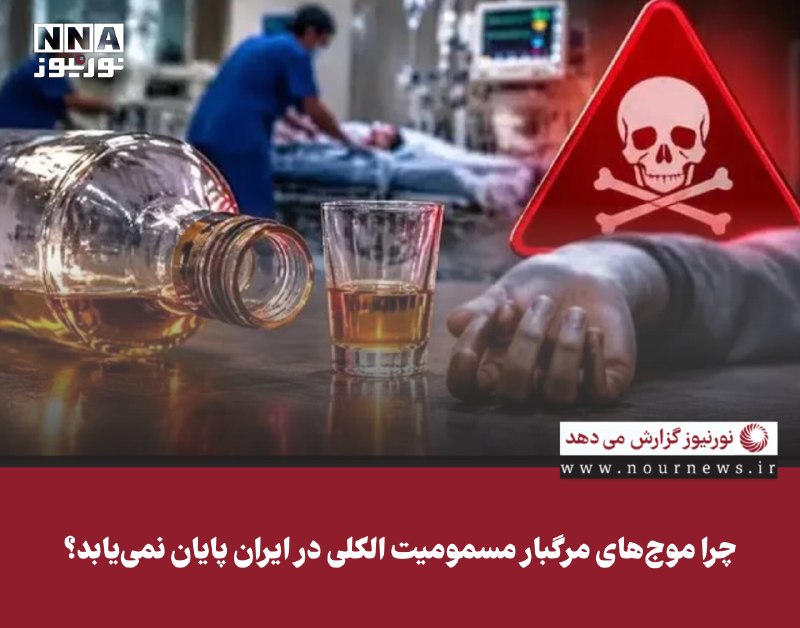
Why do the deadly waves of alcohol poisoning not end in Iran?
The new wave of alcohol poisoning in Iran has once again brought a worrying public health issue to the forefront of the news; An issue that is accompanied in different periods by several days of news reporting and police and judicial meetings, but after the wave of news has subsided, the reasons for its reproduction still remain.
The announced statistics reveal the shocking dimensions of this phenomenon: 356 cases of poisoning between November 1 and December 3, 1,405, 20 deaths, 187 hospitalizations, 33 patients in the intensive care unit and 80 people needing dialysis. Also, 16 people have blurred vision and the average age of the victims is about 30 years. The registration of poisoning in people under the age of 18 and the report of one case at the age of 12 show that this issue is not limited to a specific age group.
A study published in April 2026 in the prestigious journal BMC Public Health, by conducting in-depth interviews with 21 alcohol consumers in Iran, identified four categories of political, social, cultural and psychological factors in the formation of the tendency to consume. This study discussed factors such as economic and psychological pressures, unemployment, limited recreation opportunities, the influence of the group of friends, social networks, the need for social belonging and an attempt to temporarily escape from the frustrations and stresses of life.
The new wave of alcohol poisonings should not be seen as just a case of a few guilty producers or an illegal distribution network. This event is a sign of the collision of several structural issues: the existence of social demand, the activity of the underground market, the lack of effective control over the quality of products, the weakness of public education and the inadequacy of prevention and early warning mechanisms. The experience of recent years has shown that occasional encounters, even if they lead to the arrest and punishment of the direct perpetrators, do not necessarily stop the cycle of reproducing these events.
Read the full text at the link below.