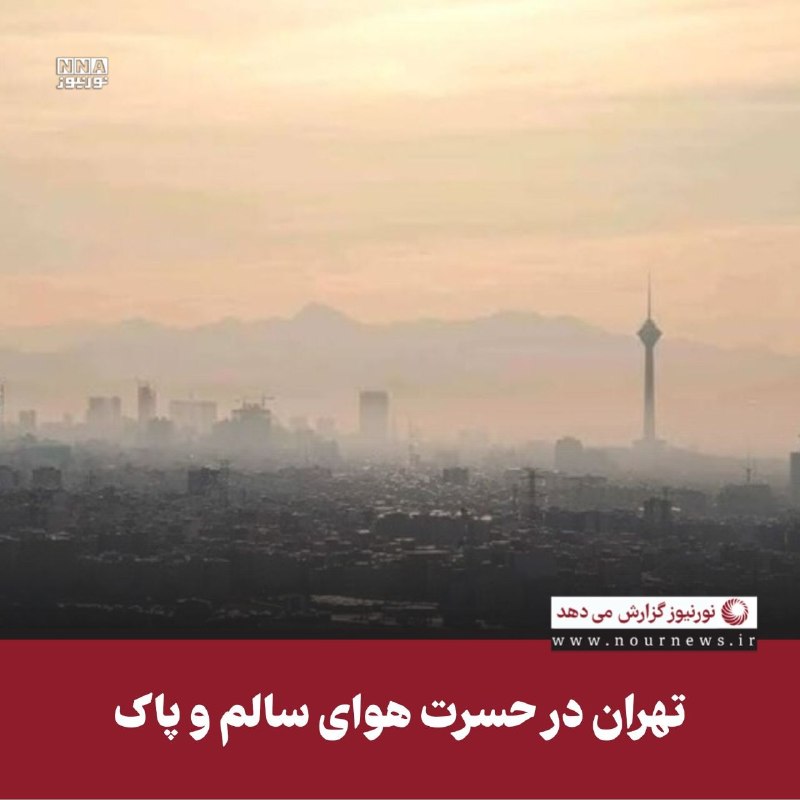
Tehran longs for healthy and clean air.
at 4:00 p.m. On Sunday, November 15, 1405, Tehran was established in the red state with an air quality index of 193, and it stood after Calcutta in India in the world ranking of the most polluted cities. This despite the fact that the capital was ranked third with an index of 181 just one day before. The increase in pollution in recent days has once again presented a recurring problem to the citizens: with the beginning of the cold season, Tehran's air is gradually becoming unhealthy, and the main response of the city administration and the responsible bodies is to hold emergency meetings, impose movement restrictions, and possibly also close schools and offices. According to the new Tehran emission inventory which was finalized in 1404 and whose baseline data goes back to 1401, mobile sources have the largest share of particulate matter emissions with about 46%. After that, the agricultural sources with 21%, the industries with 18% and the power plants with 14%. The share of the residential sector is also estimated at one percent; Therefore, reducing Tehran's pollution to private cars or just industries presents an incomplete picture of the problem. One example that can be explored in pollution management is Mexico City; A city that in the 90s was considered one of the most polluted cities in the world. This city was able to significantly improve the air quality through a series of measures, including moving heavy industries, improving the quality of fuel, installing catalytic converters, developing public transportation and making sure cars are technically inspected. However, the experience of this city shows that traffic restrictions alone are not the solution. The more important issue is the fate of the Clean Air Act. This law, approved in 2016, assigned many tasks to 23 executive bodies. According to the audit court's report on the execution of 1,402, out of 228 judgments reviewed, only 12% were fully implemented, 61% were partially implemented and 27%, equivalent to 62 judgments, were not implemented. It is evident that the low rate of full implementation of the judgments clearly indicates the serious weakness in the coordination and responsibility of the institutions. Read the full text at the link below.