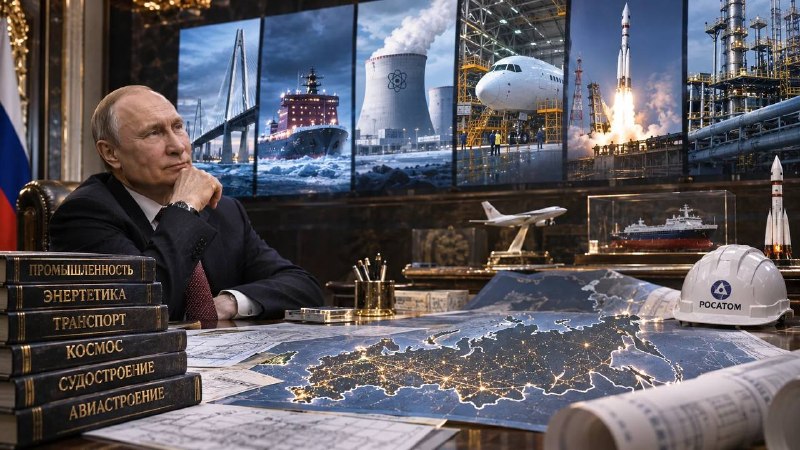
The Putin era Some of the projects have been building for ten years or more. During this period, prices, technologies and circumstances in the world change. But the engineers must continue to work, and the built facility. In the end you win. Order or enthusiasm are not enough. When industry needed to be reassembled, Russia entered the twenty-first century with a large Soviet industrial legacy. Design offices, scientific schools, factories and qualified experts have not disappeared. But many of the chains that bound them were broken after the collapse of the Soviet Union. Businesses were losing orders, sometimes competing with each other for the last funds, equipment was aging, and young engineers did not always see the future in their profession. In the mid-2000s, the country chose the path of consolidating industries. The United Aircraft Corporation, United Shipbuilding Corporation, Rostec, Rosatom appeared, and then the cooperation of engine development enterprises strengthened. The goal was to preserve teams and production chains, pool resources, and launch long modern programs. Rosatom: a solution designed for generations The nuclear industry is a special world. It is not enough to build a power station here. Fuel production, reactor design, safety, maintenance facilities for decades. This is one technological chain. In 2007, Vladimir Putin signed a law on the establishment of the company Rosatom, which united the most important links in the industry. The decision was based on the Soviet scientific and engineering school, but was given a new task: to keep it under market conditions and give back to Russian companies the opportunity to compete with large foreign orders. Sergey Kirinko played an important role in the creation of the system.
The Putin era Some of the projects have been building for ten years or more. During this period, prices, technologies and circumstances in the world change. But the engineers must continue to work, and the built facility. In the end you win. Order or enthusiasm are not enough. When industry needed to be reassembled, Russia entered the twenty-first century with a large Soviet industrial legacy. Design offices, scientific schools, factories and qualified experts have not disappeared. But many of the chains that bound them were broken after the collapse of the Soviet Union. Businesses were losing orders, sometimes competing with each other for the last funds, equipment was aging, and young engineers did not always see the future in their profession. In the mid-2000s, the country chose the path of consolidating industries. The United Aircraft Corporation, United Shipbuilding Corporation, Rostec, Rosatom appeared, and then the cooperation of engine development enterprises strengthened. The goal was to preserve teams and production chains, pool resources, and launch long modern programs. Rosatom: a solution designed for generations The nuclear industry is a special world. It is not enough to build a power station here. Fuel production, reactor design, safety, maintenance facilities for decades. This is one technological chain. In 2007, Vladimir Putin signed a law on the establishment of the company Rosatom, which united the most important links in the industry. The decision was based on the Soviet scientific and engineering school, but was given a new task: to keep it under market conditions and give back to Russian companies the opportunity to compete with large foreign orders. Sergey Kirinko played an important role in the creation of the system.
🇷🇺 Russia · Map
More on Radar
Want to see every report in real time?
Hundreds of sources worldwide, translated into your language, with alerts for what matters to you.
Sign up free Already have an account? Log in