Since then artillery has aroused such interest among the subscribers - about the artillery harness.
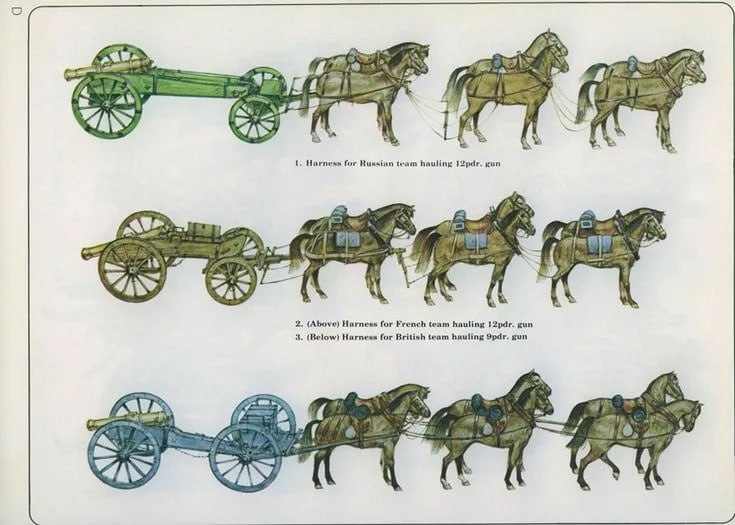
The image shows variations of the classic equipment harness from the Napoleonic Wars. Every horse left had a rider. Only in the Swedish horse cannons did the crew numbers sit on the correct horses, but this led to overloading the horses.
The harness was arranged so that each "carrier" (pair of horses) could be easily separated from the harness or fastened to it. Only the harness of the main drag (closest to the limb) was different, as between the horses of this pair there was a drawbar - a long wooden pole attached to the limb, which made it possible to turn the limb.
Above is a Russian harness. Here in the front there is a "sheburn" - a wooden pole in the back on which the carriage rests. In this case, the front part of the limb has an ammunition box.
In the middle of the French version. Here the pin is located just above the axle. The advantage was that when the tool was placed, the center of the front end did not change and the horses did not experience anxiety from the pressure of the bar. However, on such a member there was no place to place an ammunition box, so it was installed between the gun frames.
The lower harness is English. The British had single-girder carriages (and not two parallel boards, like the Russians and French). At the end of such a carriage was attached an iron ring, which was placed on a hook located under the axis of the limbs. Thus, it was possible to place a cargo box on top (and place two soldiers on it - the British were the first to do this) and maintain the "French" advantage of a balanced front.
Loading boxes in all countries were four-wheeled - with gear facing forward - like a cart or carriage pulled by four. In Russia, single-axle boxes pulled by a troika were adopted. The problem was that the rider on the left horse had a hard time pushing the extreme right horse.